
About wycoa
The establishment of the Wyoming Center on Aging (WyCOA) is a result of the efforts of the staff, leadership, and Advisory Council to the Wyoming Geriatric Education Center and the College of Health Sciences at the University of Wyoming. Several years were spent designing, planning, and developing this new center. The need for a Wyoming Center on Aging is great. Wyoming is one of the most rapidly aging states, and by 2030 is projected to be the state with the highest concentration of individuals over 85. The benefits of a Center on Aging include connecting Wyoming residents, researchers, service providers, and educators, as well as fostering innovative aging research, training health care providers, disseminating evidence-based practices, and serving as a resource for older adults and their family caregivers.
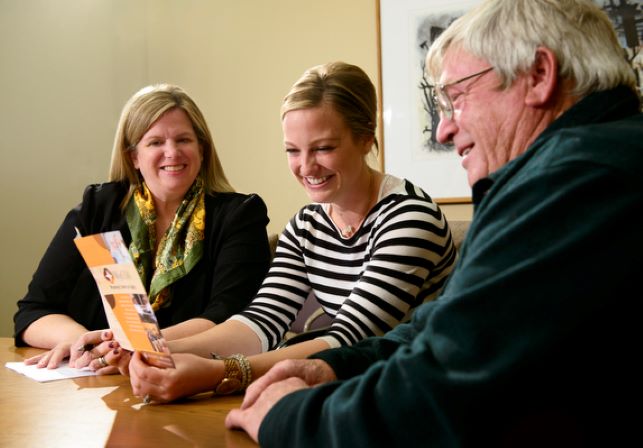
Download the WyCOA Brochure today!
WyCOA: A HRSA Geriatric Workforce Enhancement Program
The Health Resources and Services Administration awarded the $5 million of funding through the Geriatrics Workforce Enhancement Program (GWEP). The Wyoming GWEP will educate and train the primary care and geriatrics workforces and other appropriate specialties to provide age-friendly and dementia-friendly care for older adults. “Age-friendly healthcare is a growing movement that helps to provide the best care possible by focusing on what matters to older adults, reducing potential harms that older adults face more than others, and ensuring that older adults and caregivers are engaged in and satisfied with their care,” said Dr. Carrico. “Programs like the GWEP allow Wyoming to use evidence-based and innovative strategies to ready its workforce to meet the needs of our growing aging population,” said McKibbin. FOCUS: Age-Friendly Health Systems. The Wyoming Center on Aging employs an Age-Friendly approach. The 4M's of Age-Friendly Care (i.e., What Matters to Older Adults, Medications, Mentation, and Mobility) are integrated throughout service provision, workforce training, clinical research, and program evaluation. Learn more about Age-Friendly and our efforts!
healthier wyoming
In partnership with the Wyoming Department of Health Chronic Disease Prevention Program, WyCOA's Healthier Wyoming Iniatitive works to guide public health professionals and communities in taking action, advancing health equity, and reversing the epidemic of diabetes, heart disease, and stroke. The goal of the Healthier Wyoming website is to empower all Wyoming residents to take charge of their health by providing a comprehensive directory of chronic disease prevention and management resources throughout the state.
Learn more about WyCOA: Read the latest WyCOA Quarterly Newsletter
Sign up for the WyCOA email newsletter today!
PRWORA Information and Definitions
The Public Responsibility and Work Opportunity Reconciliation Act (PRWORA) mandates the verification of eligibility for federal public benefits. University programs at WyCOA that are federally funded require verification of eligibility for all attendees. Under PRWORA only individuals who are U.S. Citizens, U.S. Non-Citizen Nationals, or Qualified Aliens (as defined in the definitions below), are elidgible to benefit from these programs.
U.S. Non-Citizen National
(1) A person born in an outlying possession[1] of the United States on or after the date of formal acquisition of such possession;
(2) A person born outside the United States and is outlying possessions of parents both of whom are nationals, but not citizens, of the United States, and have had a residence in the United States, or one of its outlying possessions prior to the birth of such person;
(3) A person of unknown parentage found in an outlying possession of the United States while under the age of five years, until shown, prior to attaining the age of twenty-one years, not to have been born in such outlying possessions; and
(4) A person born outside the United States and its outlying possessions of parents one of whom is an alien, and the other a national, but not a citizen, of the United States who, prior to the birth of such person, was physically present in the United States or its outlying possessions for a period or periods totaling not less than seven years in any continuous period of ten years -
(A) during which the national parent was not outside the United States or its outlying possessions for a continuous period of more than one year, and
(B) at least five years of which were after attaining the age of fourteen years.
The proviso of section (301(g) shall apply to the national parent under this paragraph in the same manner as it applies to the citizen parent under that section.
Qualified Alien
(1) an alien who is lawfully admitted for permanent residence under the Immigration and Nationality Act [8 U.S.C. 1101 et seq.],
(2) an alien who is granted asylum under section 208 of such Act [8 U.S.C. 1158],
(3) a refugee who is admitted to the United States under section 207 of such Act [8 U.S.C. 1157],
(4) an alien who is paroled into the United States under section 212(d)(5) of such Act [8 U.S.C. 1182(d)(5)] for a period of at least 1 year,
(5) an alien whose deportation is being withheld under section 243(h) of such Act [8 U.S.C. 1253] (as in effect immediately before the effective date of section 307 of division C of Public Law 104–208) or section 241(b)(3) of such Act [8 U.S.C. 1231(b)(3)] (as amended by section 305(a) of division C of Public Law 104–208),
(6) an alien who is granted conditional entry pursuant to section 203(a)(7) of such Act [8 U.S.C. 1153(a)(7)] as in effect prior to April 1, 1980,
(7) an alien who is a Cuban and Haitian entrant (as defined in section 501(e) of the Refugee Education Assistance Act of 1980), or
(8) an individual who lawfully resides in the United States in accordance with a Compact of Free Association referred to in section 1612(b)(2)(G) of this title.
(9) Treatment of certain battered aliens as qualified aliens
(1) an alien who—
(A)has been battered or subjected to extreme cruelty in the United States by a spouse or a parent, or by a member of the spouse or parent’s family residing in the same household as the alien and the spouse or parent consented to, or acquiesced in, such battery or cruelty, but only if (in the opinion of the agency providing such benefits) there is a substantial connection between such battery or cruelty and the need for the benefits to be provided; and
(B)has been approved or has a petition pending which sets forth a prima facie case for—
(i)status as a spouse or a child of a United States citizen pursuant to clause (ii), (iii), or (iv) of section 204(a)(1)(A) of the Immigration and Nationality Act [8 U.S.C. 1154(a)(1)(A)(ii), (iii), (iv)],
(ii)classification pursuant to clause (ii) or (iii) of section 204(a)(1)(B) of the Act [8 U.S.C. 1154(a)(1)(B)(ii), (iii)],
(iii)suspension of deportation under section 244(a)(3) of the Immigration and Nationality Act [8 U.S.C. 1254(a)(3)] (as in effect before the title III–A effective date in section 309 of the Illegal Immigration Reform and Immigrant Responsibility Act of 1996).[1]
(iv)status as a spouse or child of a United States citizen pursuant to clause (i) of section 204(a)(1)(A) of such Act [8 U.S.C. 1154(a)(1)(A)(i)], or classification pursuant to clause (i) of section 204(a)(1)(B) of such Act [8 U.S.C. 1154(a)(1)(B)(i)]; [2]
(v)cancellation of removal pursuant to section 240A(b)(2) of such Act [8 U.S.C. 1229b(b)(2)];
(2)an alien—
(A)whose child has been battered or subjected to extreme cruelty in the United States by a spouse or a parent of the alien (without the active participation of the alien in the battery or cruelty), or by a member of the spouse or parent’s family residing in the same household as the alien and the spouse or parent consented or acquiesced to such battery or cruelty, and the alien did not actively participate in such battery or cruelty, but only if (in the opinion of the agency providing such benefits) there is a substantial connection between such battery or cruelty and the need for the benefits to be provided; and
(B)who meets the requirement of subparagraph (B) of paragraph (1);
(3)an alien child who—
(A)resides in the same household as a parent who has been battered or subjected to extreme cruelty in the United States by that parent’s spouse or by a member of the spouse’s family residing in the same household as the parent and the spouse consented or acquiesced to such battery or cruelty, but only if (in the opinion of the agency providing such benefits) there is a substantial connection between such battery or cruelty and the need for the benefits to be provided; and
(B)who meets the requirement of subparagraph (B) of paragraph (1); or
(4)an alien who has been granted nonimmigrant status under section 101(a)(15)(T) of the Immigration and Nationality Act (8 U.S.C. 1101(a)(15)(T)) or who has a pending application that sets forth a prima facie case for eligibility for such nonimmigrant status.
This subsection shall not apply to an alien during any period in which the individual responsible for such battery or cruelty resides in the same household or family eligibility unit as the individual subjected to such battery or cruelty.
After consultation with the Secretaries of Health and Human Services, Agriculture, and Housing and Urban Development, the Commissioner of Social Security, and with the heads of such Federal agencies administering benefits as the Attorney General considers appropriate, the Attorney General shall issue guidance (in the Attorney General’s sole and unreviewable discretion) for purposes of this subsection and section 1631(f) of this title, concerning the meaning of the terms “battery” and “extreme cruelty”, and the standards and methods to be used for determining whether a substantial connection exists between battery or cruelty suffered and an individual’s need for benefits under a specific Federal, State, or local program.
[1]Section 101(a)(21) of the Immigration and Nationality Act: The term "outlying possessions of the United States" means American Samoa and Swains Island.
reach out with any questions!


The University of Wyoming has earned its Research Level 1 (R1) status from the Carnegie
Classification of Institutions of Higher Education, placing Wyoming's only four-year
university with the top research universities in the United States.
WyCOA is supported by the Health Resources and Services Administration (HRSA) of the
U.S. Department of Health and Human Services (HHS) as part of an award totaling $5,000,000
with 0% financed with nongovernmental sources. The contents are those of the author(s)
and do not necessarily represent the official views of, nor an endorsement, by HRSA,
HHS or the U.S. Government.