Main hub. I suggest setting a bookmark to this
page. RELOAD/REFRESH FROM TIME TO TIME!!
Underlined text is generally hot-linked (mostly blue; some blue text
in internal pages is not underlined and not hotlinked)
Glossary of terms used in Population Genetics
Download "WebSoftware.doc" list of software resources for pop. gen. and some phylogenetics
Go to web page outlining major aspects of analyzing genetic population structure (WAAP.html)
(some important measures to calculate, very basic intro. to the practicalities of running a few of the many software choices)
Jump to reading list and syllabus Go to Dave McDonald's home page
Lecture Notes
Go to Lecture 1 (Mon 25-Aug-08, Wed 27-Aug, Fr 29-Aug) [Intro. to course -- topics covered, essentials of DNA as a genetic marker]
Go to Lecture 2 (Fr-29-Aug-08 to Fr 5-Sep) [Overview of phylogenetics]
Go to Practicum # 1 (Fr 5-Sep) [Tree-building with PHYLIP ]Go to Lecture 2a (Wed 10-Sep) [Speciation and hybridization]
Practicum 2 (Fr 12-Sep) [Tree-building with PAUP -- no web notes]Go to Lecture 3 (Mon 15-Sep & Fr 19-Sep) [Population Genetics I -- Intro., Hardy-Weinberg]
Go to Lecture 4 (Mon 22-Sep) [Population Genetics II -- Heterozygosity, HE or D; intro. to FST]
Go to Lecture 5 (Fr 26-Sep & Weds. 1-Oct) [Population Genetics III -- Wahlund effect, isolate breaking, PHSC approach to FST]
Practicum 3 (Fr 26-Sep) [More FStat software exercises; see data and instruction file in WyoWeb folder under "Practica"]
or Download it from here (guide to using Exel add-in Microsatellite Toolkit and program FStat on campus computers)Practicum 4 (Fr 3-Oct) [Interpretation of FStat software output; Assignment tests]
Go to the Assignment overview web pageGo to Lecture 6 (Wed 8-Oct) [Population Genetics IV -- Genetic distances: Cavalli-Sforza chord, Nei's, Reynolds' ]
Go to Lecture 7 (Tu 10-Oct) [Population Genetics V -- Ne, effective population size; overview of alternative markers]Go to web page describing how to calculate FST from heterozygosities (FST.html).
Lecture 7a. (Fr 17-Oct) Go to web page outlining major aspects of analyzing genetic population structure (WAAP.html)
(some important measures to calculate, very basic intro. to the practicalities of running a few of the many software choices)Go to Lecture 8 (Wed 22-Oct) [Population Genetics VI -- intro. to microsatellites as a genetic marker]
Mon 27-Oct Case history: AFLP and mtDNA analyses of hybridization in native fish (Powerpoint available on WyoWeb)
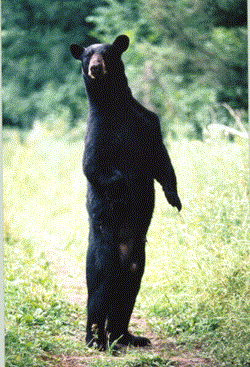
Go to Lecture 9 [Population Genetics VII -- Microsatellite analyses of black bear genetic structure]
Week of 3 to 7-Nov. Lectures and practicum on using the software Structure.
See WyoWeb folders (Practicum 6 folder, HW4 folder and Software guide folder)
Download Word document on using StructureGo to Lecture 11 (Wed 19-Nov) [Conservation genetics]
Go to Lecture 12 (Wed 3-Dec) [Highlights of the course]
Lecture notes beyond this point have not yet been revised for 2008
Homework pages
Download Word document PHYLIPinfo.doc Download Word document on using Structure
Download Excel sheet of worked example of UPGMA, Neighbor-joining and Fitch-Margoliash tree from great ape 5-taxon distance matrix
For full list of references (~ 1,400 references, many with abstracts), e-mail me and I will send you a Word attachment or transfer it to a flash drive you bring to my office or to class.
Download Syllabus (excluding calendar page and reading list)
Download "WebSoftware.doc" list of software resources
Glossary of terms used for Genetic/Molecular Markers
Download Excel spreadsheet guide (Hexp.XL) to calculating expected heterozygosity, Hexp (or as Bruce Weir prefers to call it, Gene Diversity, D)
Dr. David McDonald BioSciences
413 dbmcd@uwyo.edu
766-3012
Office hours W 11-12, Th 10:00-12:00
or
by appointment
A note on navigating the web pages:
Figures, Equations and Required Readings are labeled in a "chapter-like"
manner, with each lecture as the equivalent of a chapter. That is,
Lecture 1's web page will be "Chapter 1". All Figures in that web
page will be numbered Fig. 1.1, 1.2, ...1.n
for the n Figures
it includes. The same will be true for Equations (numbers for which
will be toward the right-hand margin). I will try to hotlink most
references to Figures or Equations WITHIN a web page, but may not do so
BETWEEN web pages. That is, a reference to Eqn 1.1 in the 2nd web
page ("Chapter 2") might require you to jot that number down and surf back
later. The hotlinks will be the standard underline format.
I will have links between all the web pages that I design for this course. I may even put in some external links. Come see me
if you need help on browsing the web pages. Please let us know, also,
if you find typos, pages that won't print properly, or other glitches.
Reading numbers may change if the lecture schedule
shifts -- the updated list of number will be reposted occasionally both
on the web and in the WyoWeb folders.
Return to top of page