
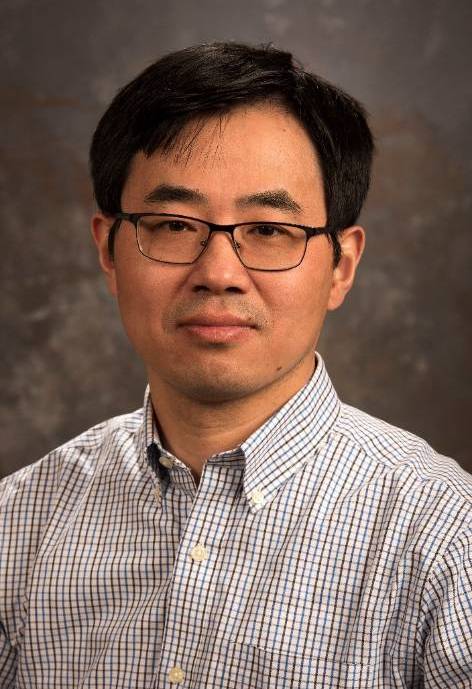
Haibo Zhai, Ph.D.
Professor, Roy & Caryl Cline Distinguished Chair in Engineering and Wyoming Excellence Chair
Civil and Architectural Engineering and Construction Management
Education
- B.S., Water Supply and Drainage Engineering, Xi’an University of Technology, 1999
- M.S., Environmental Engineering, Tongji University, 2002
- Ph.D., Environmental Engineering, North Carolina State University, 2008
Academic Appointments
- 8/2020-present, Associate Professor/Professor Department of Civil and Architectural Engineering, University of Wyoming
- 2021-present, Adjunct Associate Professor/Professor, Department of Engineering and Public Policy, Carnegie Mellon University
- 7/2017-8/2020, Associate Research Professor, Department of Engineering and Public Policy, Carnegie Mellon University
- 12/2012-6/2017, Assistant Research Professor, Department of Engineering and Public Policy, Carnegie Mellon University
- 12/2010-8/2020, Manager for Integrated Environmental Control Model Development, Carnegie Mellon University
- 4/2008-11/2010, Postdoctoral Fellow, Carnegie Mellon University
- 1/2008-3/2008, Postdoctoral Research Associate, North Carolina State University
Teaching Interests
- Carbon Capture and Storage
- Water for Energy
- Energy and Environmental Systems
Bio
Haibo Zhai is the Roy & Caryl Cline Distinguished Chair in Engineering, a Wyoming Excellence Chair, and a Professor of Environmental Engineering at the University of Wyoming (UW). He is also an Adjunct Professor in the School of Energy Resources and the School of Computing at UW and in the Department of Engineering and Public Policy at Carnegie Mellon University (CMU). He is a visiting scholar at the University of Oxford’s Saïd Business School for the fall 2026 term. Prior to moving to Wyoming, he was a research professor at CMU and a key developer of the Integrated Environmental Control Model (IECM), a computer tool used worldwide for power plant modeling and techno-economic assessment. Now he serves as Director for the IECM development. His work on carbon capture and storage has been referenced in the U.S. national rulemaking for controlling power sector carbon dioxide emissions and in the IPCC Sixth Assessment Report. He has been invited as an ad-hoc reviewer by the U.S. National Academies of Sciences, Engineering, and Medicine, and numerous research funding agencies, including the National Science Foundation (U.S.), the U.S. Department of Energy, the Dutch Research Council (Netherlands), the Knowledge Foundation (Sweden), and the National Science Centre (Poland). He is a lead author for the 2027 IPCC Methodology Report on Carbon Dioxide Removal Technologies, Carbon Capture, Utilization, and Storage for National Greenhouse Gas Inventories. He also serves on the advisory board of iScience and npj Environmental Social Sciences. He is a member of the American Association for the Advancement of Science. He was an appointed member of the Transportation Research Board’s Standing Committee on Transportation and Air Quality (2011-2020)
Research
Professor Zhai conducts systems research in low-carbon energy and environmental sustainability. His research addresses technical, economic, and policy issues related to energy and the environment. His research interests mainly include carbon capture, utilization and storage, hydrogen energy, bioenergy, nuclear energy, and the energy-water nexus under carbon constraints for climate change mitigation. His research involves a combination of computational modeling for energy and environmental systems with engineering economics, life cycle assessment, risk analysis, and policy analysis and provides scientific support for technological and policy developments.
Selected Journal Publications
- Qin, D., Zhai, H., & Quillinan, S. (2025). Comparative life cycle water use assessment of diverse hydrogen production pathways. Environmental Science & Technology, 59(47), 25237–25250.
- Wu, W., Zhai, H., & Holubnyak, E. (2024). Technological evolution of large-scale blue hydrogen production toward the U.S. Hydrogen Energy Earthshot. Nature Communications, 15, 5684.
- Wu, Z., Zhai, H., Grol, E., Able, C., & Siefert, N. (2023). Treatment of brackish water for fossil power plant cooling. Nature Water, 1, 471–483.
- Dindi, A., Coddington, K., Garofalo, J. F., Wu, W., & Zhai, H. (2022). Policy-driven potential for deploying carbon capture and sequestration in a fossil-rich power sector. Environmental Science & Technology, 56(14), 9872–9881.
- Wu, Z. & Zhai, H. (2021). Consumptive life cycle water use of biomass-to-power plants with carbon capture and sequestration. Applied Energy, 303, 117702.
- Zhai, H. (2019). Advanced membranes and learning scale required for cost-effective post-combustion carbon capture. iScience,13, 440–451.
- Mantripragada, H., Zhai, H., & Rubin, E.S. (2019). Boundary Dam or Petra Nova – which is a better model for CCS energy supply? International Journal of Greenhouse Gas Control, 82, 59–68.
- Peng, W., Wagner, F., Ramana, M. V., Zhai, H., Small, M., Dalin, C., Zhang, X., & Mauzerall, D. L. (2018). Managing China’s coal power plants to address multiple environmental objectives. Nature Sustainability, 1, 693–701.
- Zhai, H., & Rubin, E.S. (2018). Systems analysis of physical absorption of CO2 in ionic liquids for pre-combustion carbon capture. Environmental Science & Technology, 52(8), 4996–5004.
- Zhai, H., Ou, Y., & Rubin, E. S. (2015). Opportunities for decarbonizing existing US coal-fired power plants via CO2 capture, utilization and storage. Environmental Science & Technology, 49(13), 7571–7579.
- Zhai, H., & Rubin, E. S. (2013). Techno-economic assessment of polymer membrane systems for postcombustion carbon capture at coal-fired power plants. Environmental Science & Technology, 47(6), 3006–3014.
- Rubin, E. S., & Zhai, H. (2012). The cost of carbon capture and storage for natural gas combined cycle power plants. Environmental Science & Technology, 46(6), 3076–3084.
- Zhai, H., Rubin, E. S., & Versteeg, P. L. (2011). Water use at pulverized coal power plants with postcombustion carbon capture and storage. Environmental Science &Technology, 45(6), 2479–2485.
- Zhai, H., Frey, H. C., & Rouphail, N. M. (2008). A vehicle-specific power approach to speed-and facility-specific emissions estimates for diesel transit buses. Environmental Science & Technology, 42(21), 7985–7991.

The University of Wyoming has earned its Research Level 1 (R1) status from the Carnegie Classification of Institutions of Higher Education, placing Wyoming's only four-year university with the top research universities in the United States.