
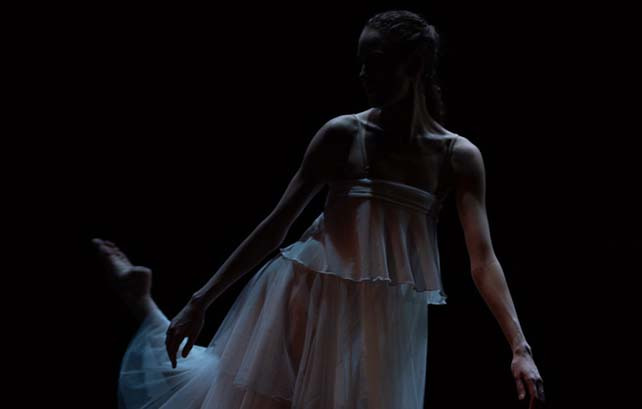
An Invitation to Critical Feeling: How to Watch Dance
Sarah Lass | Assistant Instructional Professor
Published February 19, 2026
I have been dancing for twenty-five years
and teaching dance for almost a decade. During these many years, I have identified one common anxiety that limits students’ willingness to deeply engagement with dance performances: “I don’t get it.”
I understand that this anxiety doesn’t come out of nowhere. Elite, privileged spaces and traditions have historically shaped spaces of concert dance, and many venues still carry unspoken rules about how to dress, behave, and respond—norms that can feel baffling and exclusionary. Dance is also often culturally coded as feminine, which can shape who feels welcomed in these spaces. And because contemporary work frequently asks audiences to tune into sensation and emotion rather than follow a clear narrative, it can feel quite vulnerable—especially in a culture that often privileges detachment and logic over feeling.
While all of these are very real forces, the reality is this: You don’t need technical vocabulary, performance experience, or a background in dance to have a meaningful experience watching it. You just need curiosity- curiosity and openness.
Contemporary concert dance isn’t like Dancing With the Stars, and it’s not built for TikTok. It doesn’t always tell a clear story, and it’s not always meant to be primarily “entertaining.” For me, the experience of watching concert dance is much closer to the experience of looking at a painting or listening to a poem; it invites you to slow down, to notice details, to feel, to associate, to interpret.
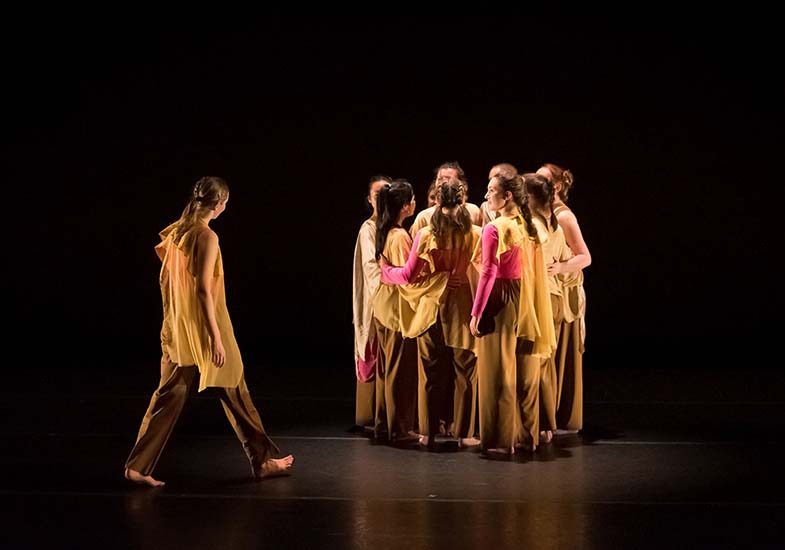
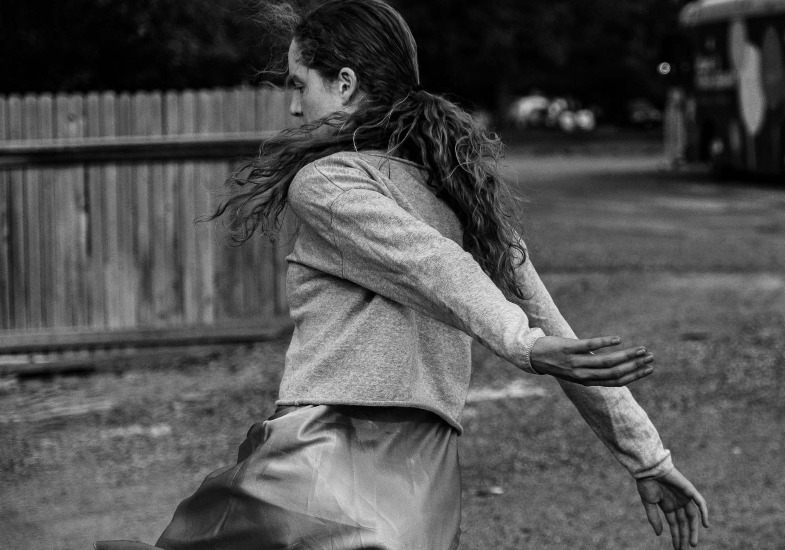
If you’re feeling nervous about attending the dance concert on March 6-8, here are a few simple ways to watch:
- Look for patterns. Do movements, relationships, or moments repeat? Do they evolve? Repetition in dance often works like a thesis statement—it establishes an idea and then complicates it.
- Notice relationships. How do the dancers relate to each other? Are they moving in unison, in opposition, in isolation? How are they in relation to the sound? These relationships are often where meaning lives.
- Pay attention to space. Where does the action happen? How do dancers relate to the space around them? Do they interact with it or ignore it? Are their movements very direct or more indirect? Does the space feel large or small? What are the lights doing?
- Notice weight and flow, in addition to the visual design of bodies. This one might sound strange, but the way in which movement mobilizes a dancer’s weight relative to gravity is a critical way in which meaning is made (it’s not just about the shape of the movements). Is the weight of dancers’ bodies grounded and heavy, lifted and airborne, fluid and easeful, sharp and accented, etc.?
If all else fails, just remember: you don’t have to “get” it; you just have to get curious about it.
For me, when “meaning” emerges in a dance, it feels more like a revelation as opposed to a narrative; when a dance makes sense, its various components accumulate into something that “seems inevitable, almost unarguable. It feels like a story even when there is no story.”[1] But I, as an audience member, must be actively involved in the process, continually opening myself to the dance, continually re-sparking my own curiosity about it.
[1] Jonathan Burrows, A Choreographer’s Handbook. (New York: Routledge, 2010), 40.

The University of Wyoming has earned its Research Level 1 (R1) status from the Carnegie Classification of Institutions of Higher Education, placing Wyoming's only four-year university with the top research universities in the United States.