
Don Jarvis
Professor Emeritus
Molecular Biology
Contact Information
DLJarvis@uwyo.edu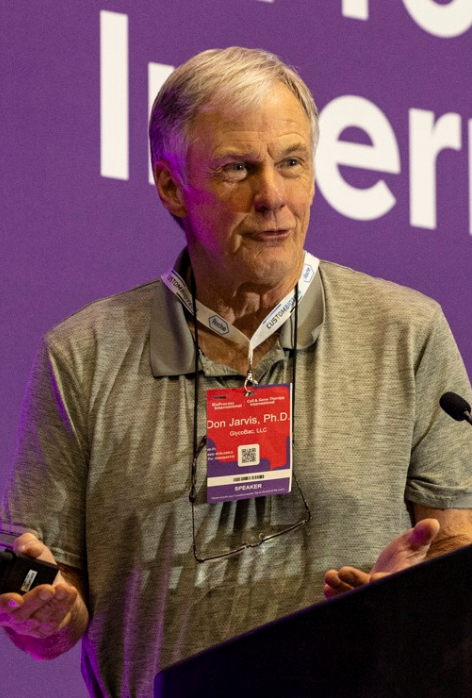
Born in a log cabin and raised by wolves, Don later earned his B.S. (1978) and M.S. (1980) degrees in Microbiology at Idaho State University and a Ph.D. (1986) in Virology at Baylor College of Medicine. Don’s training as an undergraduate and M.S. student sparked an intense interest in virology that led him to apply to the Ph.D. program in the only virology Department in the country at the time at Baylor College of Medicine. Don’s major Professor was Dr. Janet Butel, a DNA tumor virus expert, and his project focused on biosynthesis, modification, and transport of the SV40 large tumor antigen. His work on SV40 not only crystallized Don’s passion for virology but unexpectedly led him into the new world of glycobiology. In 1987, Don was swept into the perfect storm in the form of a postdoctoral training opportunity that would allow him to pursue his interests in virology and glycobiology, which he believed he could develop into a productive niche for a career in research. So, he accepted the opportunity offered by Dr. Max Summers at Texas A&M University, which was to establish an independent program focused on elucidating protein processing pathways in the baculovirus-insect cell system (BICS). By 1990, Don had made some progress, won a competitive USDA grant, published five papers in this area, and was hired as an Assistant Professor. By 1995, Don had won four additional competitive grants, including an NRI renewal and new NIH grant, published fourteen more papers, established his teaching credentials, and was promoted to Associate Professor with tenure. In summary, during his time at Texas A&M, Don’s group produced the first direct and detailed view of the endogenous protein N-glycosylation pathways in insect cell lines used as hosts in the BICS at the molecular level. In addition, they had invoked these findings to begin developing new BICS with improved protein glycosylation capabilities.
In 1997, Don moved his lab to the Dept. of Molecular Biology at the University of Wyoming, where their basic research efforts remained focused on glycoprotein biosynthesis in the BICS, with more questions to pursue. However, their progress in elucidating the endogenous N-glycosylation pathway had already explained a major limitation of the BICS, which was the inability to produce recombinant proteins with human-type N-glycans. Even before the lab moved to Wyoming, this information enabled Don to initiate efforts to pursue his ultimate goal of creating improved BICS with “humanized” insect cell N-glycan processing pathways. The idea was to “glycoengineer” insect cell pathways in ways that would enable them to produce recombinant N-glycoproteins with human-type N-glycans. Ultimately, these efforts yielded insect cell lines and baculovirus expression vectors comprising improved BICS, with the ability to produce humanized N-glycoproteins.
From the onset of Don’s time at Texas A&M, he had begun to acquire some entrepreneurial
skills by observing Dr. Summers moving through the process of commercializing the
original BICS. Don quickly realized his own efforts to improve the BICS would likely
be of interest to scientists and their companies using the BICS in the biotechnology
sector. Thus, during his time in Texas and Wyoming, Don assembled an intellectual
property portfolio comprised of patents and licensing agreements designed to protect
the methods, tools, and glycoengineered insect cell lines and baculovirus vectors
comprising improved BICS. Together, the portfolio and materials produced provided
the foundation for a small biotechnology company with the goal of refining and commercializing
these products. This company was founded in 2011 and named GlycoBac to symbolize its
goal of humanizing protein glycosylation pathways in the baculovirus-insect cell system.
Don later identified a new opportunity for GlycoBac after adventitious viral contaminants
were identified in the two insect cell lines most commonly used as hosts in the BICS.
Realizing this might sideline all BICS as biomanufacturing platforms, Don and GlycoBac
scientists quickly developed a new insect cell isolation method and used it to isolate
new versions of these two insect cell lines with no detectable viral contaminants.
GlycoBac has patented the method and cell lines and has successfully commercialized
the new cell lines for biologics manufacturing in licensing agreements with a large
number of major biotechnology companies worldwide.
On July 1, 2024, 46 years after earning his B.S. degree in microbiology, Don retired
as a Professor of Molecular Biology at UW and accepted a Professor Emeritus position.
In this position, Don continues to try to participate as a lame duck faculty member
in the Molecular Biology Department. About two years before retiring from UW, Don
shut down GlycoBac’s R&D operations, but the company is still doing business from
an office in Don’s home. Thus, Don stays busy with efforts to nurture and expand interest
in GlycoBac’s virus-negative insect cell lines. That is, of course, as long as it
doesn’t interfere with his interests in hiking, fishing, hunting, hanging out with
his yellow lab, Jake, and, whenever possible, spending time with his son Charlie.

The University of Wyoming has earned its Research Level 1 (R1) status from the Carnegie Classification of Institutions of Higher Education, placing Wyoming's only four-year university with the top research universities in the United States.