
UW Hosts 35 Native American High School Students for Ninth Native American Summer Institute
Published June 17, 2026
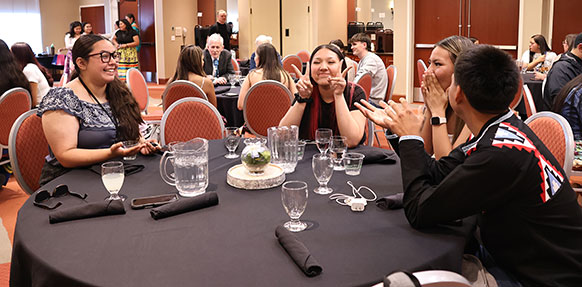
Native American Summer Institute (NASI) peer mentor Maya Molt (left), of Riverton, jokes with high school students Trin Hiwalker, Swin Hiwalker and Jordan Black, all from Ethete, at the institute’s final banquet at Hilton Garden Inn Laramie Friday, June 12. Students dressed up, including in ribbon shirts and skirts, and heard from speakers such as UW President Ed Seidel (background). During NASI, students from the Wind River Reservation and other communities came to UW, stayed in the residence halls, sampled the college experience at UW and participated in cultural activities designed to promote and maintain cultural identity. (UW Photo)
The University of Wyoming hosted 32 Native American high school students from the
Wind River Reservation and Wyoming, as well as three students from Colorado, New Mexico
and Utah, in its residence halls. Students sampled the college experience at UW and
participated in cultural activities designed to promote and maintain cultural identity
during the ninth Native American Summer Institute (NASI) June 7-13.
“This year, we really wanted to focus on campus collaboration and use our own UW resources
and partnerships we have across campus,” says Reinette Curry, director of UW’s Native
American Education, Research and Cultural Center (NAERCC). “We also were able to attend
the CSU Native Preview Day and collaborate with other Native college summer programs,
which allowed our participants to network and engage in other cultural and academic
sessions for one full day.”
Motivational speaker, youth advocate and community leader Kansas Middletent, an enrolled
member of the Lower Brule Sioux Tribe who has been working with UW’s NAERCC for the
past year, served as this year’s keynote speaker and led some leadership sessions.
The goal of the institute -- the only one of its kind in Wyoming -- is to help students
succeed, Curry says. A large part of the institute involves the uniqueness of Native
American culture and traditions, she adds. When these students come to UW campus,
they don’t have to leave the cultural piece of their identity, and experiencing UW
through the institute can help prevent culture shock during their freshman years at
UW.
A Visit from the Governor and Business Council Representatives
To encourage NASI students to engage civically, uphold their culture and pursue an
education at UW, representatives of the Northern Arapaho and Eastern Shoshone business
councils spoke to students Thursday, June 11, in UW’s Berry Biodiversity Conservation
Center.
Chairman Keenan Groesbeck, Michael Yellowplume and Sami Dresser represented the Northern Arapaho
Business Council. Chairman Wayland Large, Clinton Glick and Latonna Snyder represented
the Eastern Shoshone Business Council.
The councils were joined by Gov. Mark Gordon, who attended the institute for the first
time, and UW President Ed Seidel. This was the first time in NASI’s history these
individuals gathered in one room to interact with Native youth.
The purpose of the panel was “to highlight civic engagement and state and tribal relations
with the two sovereign nations of Wyoming,” Curry says.
The idea was born when a small group of women, including Curry and Gordon’s tribal
liaison, Anita Roman, discussed how Native youth can be encouraged to engage at the
state level as well as within tribal government while demonstrating their voices matter,
Curry says.
There are amazing students who participated in the institute, who will one day become
tribal leaders and/or elected officials for the state of Wyoming, she says, adding,
NASI wanted to put students in front of Gordon and the councils so they could hear
about the work these officials do and what their roles involve.
During the panel, Gordon explained the workings of the state government, spoke against
division and encouraged students to engage politically. He also answered a variety
of their questions, alongside Seidel and the councils, which ranged from their biggest
regrets while in office to a light-hearted “How was your day?”
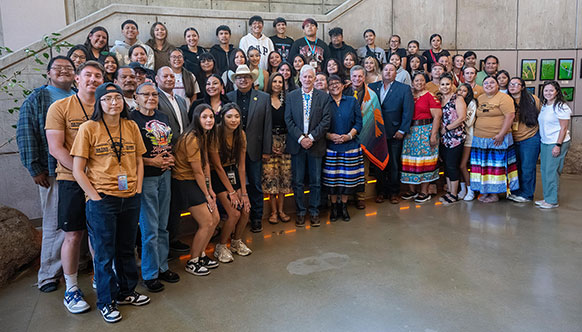
Gov. Mark Gordon, UW President Ed Seidel and representatives of the Northern Arapaho and Eastern Shoshone business councils, as well as representatives of the tribal higher education offices, visited students in the Berry Biodiversity Conservation Center Thursday, June 11, as part of the ninth Native American Summer Institute. (UW Photo)
“It has been such an honor -- and I mean that from the bottom of my heart -- to work
with these wonderful council members and the councils that have come before them to
have the chance to understand a little bit more about different governments and how
they work,” Gordon said during the panel. “And the fact that, when we’re talking about
tribes, we’re talking about nations in their own right, but also citizens of Wyoming,
and it’s given me the humility to sort of be able to say: ‘We are in this together.’”
While addressing students during the panel, Seidel informed them that UW is their
university and can open doors for whatever path they may choose to pursue. He also
highlighted resources and opportunities for Native students, including scholarships
such as the Wind River Promise Fund, which was approved by the Board of Trustees in
August. The scholarship can cover up to the full cost of undergraduate tuition and
mandatory fees for enrolled members of the Northern Arapaho and Eastern Shoshone tribes
who are residents of Wyoming and have graduated from Wyoming high schools. More information
can be found here.
“I want to encourage you, gain as much as you can from here, because this is our university,”
Large said. “We want you to come here, get your education to be a doctor, lawyer,
engineer, whatever God puts in your heart -- seek that education -- because, in return,
you’re going to be at our age, either sitting up here or you’re going to be helping
your people.”
Both councils also spoke to students about the sovereignty of the tribes and the workings
of the tribal government.
“I just wanted to say one thing for all you kids coming up, get to know your council
members, and ask them questions,” Yellowplume said, adding, “If you decide to go into
politics, tribal politics, that’ll help a lot for when you get in there. I just want
to congratulate all you guys. You guys are on a tough road. You guys are going to
be our next leaders. Just hang in there and hang tough.”
The Rest of the Week
Other cultural programming during the event included “Indigenous Agriculture, Nutrition
and Soil Health” at UW’s ACRES Student Farm. Students learned the “Four Sisters” planting
method from Richard Woodward, a horticulture specialist with UW Extension, and undergraduate
student Kaylee Brown, of Phoenix. Students planted four crops -- in this case, corn,
squash, peas and sunflowers -- to mutually benefit each other. The seeds were planted
into four dirt mounds, which were then watered with fish emulsion (a stand-in for
the normally used dead fish).
They also participated in tests and activities on soil health with UW Extension’s
Hannah Rodgers, assistant research scientist, and Assistant Extension Educator Callie
Surber. The evening concluded with Native dishes served by Denyse Ute, owner of Indigi-Meals
Pro, with the assistance of Jill Keith, head of the Department of Family and Consumer Sciences. Ute is an enrolled member of the Eastern Shoshone Tribe who recently earned her master’s
degree from UW.
On Wednesday, students travelled to Fort Collins, Colo., for CSU Native Preview Day with keynote speaker Supaman. They also visited the Museum
of Natural History and met with Collections Engagement Manager Jordan Dresser, a member
of the Northern Arapaho Tribe and a UW alumnus.
The chance to learn more about Native culture drew Jamison Spoonhunter, of Riverton,
to the weeklong institute. Spoonhunter is entering his junior year of high school,
and, while law school may be a possibility, he joined NASI specifically to gain more
cultural knowledge, he said during his first day on campus. By then, he had already
gleaned some information by listening to stories told in South Hall.
Other events on this year’s extensive schedule included academic sessions on a variety
of topics such as geographic information systems and drones; brain and neuroscience;
geology; energy; 3D visualization, pharmacy; and “Bee the Scientist,” a scientific
outreach program led by UW Ph.D. student Sabrina White.
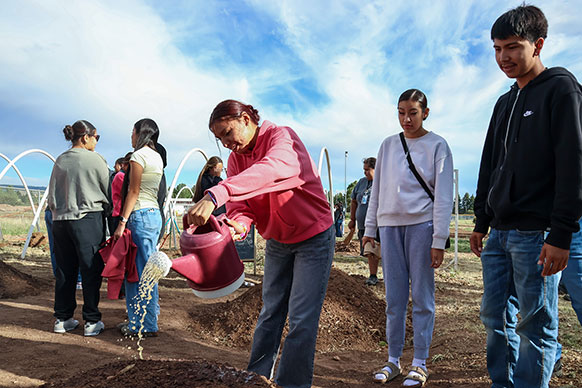
Native American Summer Institute students visited ACRES Student Farm, where they participated in several activities including the “Four Sisters” method of planting. From left are Gabriella Headley (pouring water), Takara Ferris and Marley Underwood. (UW Photo)
During these academic sessions, Maxx Fasthorse, of Riverton, was able to “see a lot
of things that I’ve never seen before in my life,” he says, including fossils during
the geology session. While he’s not sure if he’ll attend UW, NASI has provided an
opportunity to participate in an activity during the summer, a time of year where
he says he doesn’t typically do much.
Throughout the sessions and other institute activities, students were accompanied
by six peer mentors, all Native students at UW.
This year’s peer mentors included: Darwin St. Clair III, peer mentor senior and a
recent UW graduate from Fort Washakie; Jaydas BearComesOut, peer mentor junior and
a sophomore from Fort Washakie; Miles Daskivich, a junior from Cheyenne; Maya Molt,
a senior from Riverton; Georgie Moss, a junior from Arapahoe; and Justice Moss, a
recent UW graduate from Arapahoe.
“I wanted to give back to this community on campus and hopefully help to grow the
community on campus of Native students from Wind River and elsewhere,” Daskivich says.
“This community has done a great deal for me, so I want to give back, and I think
it’s an honor to be in a position to contribute to maybe get high school students
interested in the idea of going to college.”
NASI staff also included Elder-in-Residence Arydenne Sage, who is enrolled in the
Northern Arapaho Tribe and provides support to NASI’s team and students, as well as
Mary Harris, project coordinator senior for the NAERCC and NASI co-coordinator.
“Seeing NASI grow from when I was a high school student to now has been pretty incredible.
I’ve been lucky enough to be part of it as a participant, a peer mentor and now a
co-coordinator,” Harris says. “I can honestly say I believe in this program because
I’ve seen firsthand the impact it has on Native students. I started working with Reinette
during NASI in 2025, and that also was the year we had our first freshmen cohort in
the fall because of NASI. Getting to watch students take that next step from attending
the program to enrolling at the University of Wyoming has been one of the coolest
parts of this journey and a reminder of why NASI matters so much.”
Students from Wyoming and the Wind River Reservation, listed by hometown and school,
are:
-- Antyn Bell, Ethete, Wyoming Indian High School.
-- Jordan Black, Ethete, Wyoming Indian High School.
-- Tanayah Burnett, Ethete, Wind River High School.
-- Amari Ceasar, Ethete, Lander Valley High School.
-- Mitchell C’Hair, Ethete, Wyoming Indian High School.
-- Fasthorse, Ethete, Riverton High School.
-- Takara Ferris, Ethete, Wyoming Indian High School.
-- Tazmin Friday, Ethete, Lander Valley High School.
-- Trin Hiwalker, Ethete, Wyoming Indian High School.
-- Swin Hiwalker, Ethete, Wyoming Indian High School.
-- Gabriella Headley, Ethete, Wyoming Indian High School.
-- Alicia Oldman, Ethete, Lander Valley High. School.
-- Alicia Sanchez, Ethete, Wyoming Indian High School.
-- Atavia Smith, Ethete, Wind River High School.
-- Amara Trumbull, Ethete, Wyoming Indian High School.
-- Marysa Trumbull, Ethete, Wyoming Indian High School.
-- Marley Underwood, Ethete, Wyoming Indian High School.
-- Taleah Walling Bull, Ethete, Wyoming Indian High School.
-- Ariana Wallowing Bull, Fort Washakie, Chemawa Indian High School.
-- Autumn Warren, Ethete, Wyoming Indian High School.
-- Chloe Whiteplume, Ethete, Wyoming Indian High School.
-- Ava Red Willow, Ethete, Wyoming Indian High School.
-- Harlie Velarde, Ethete, Lander Valley High School.
-- Eva Brown, Fort Washakie, Lander Valley High School.
-- Emery Jo Nicholas, Fort Washakie, Wind River High School.
-- Mila Warren, Pavillion, Wind River High School.
-- TyAnne Cooper, Riverton, Wind River High School.
-- Elana Daw, Riverton, Riverton High School.
-- Spoonhunter, Riverton, Wind River High School.
--Natiya Shoyo, Fort Washakie, Wind River High School.
--Treyven Blindman, Fort Washakie, Lander Valley High School.
--Surae Trumbull, Ethete, Wyoming Indian High School.
Jordan Armour, of Albuquerque, N.M., and Cibola High School; Delilah Gover, of Aurora,
Colo., and Frontier High School; and Loveliah Underwood, of Salt Lake City, Utah,
and Granger High School, attended NASI from out of state.
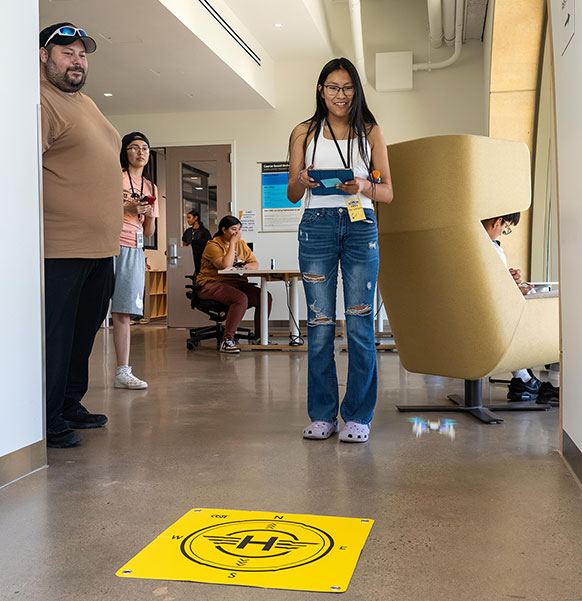
One of the Native American Summer Institute’s (NASI) academic sessions was about geographic information systems and drones. From left are Shawn Lanning, a geospatial specialist at the Wyoming Geographic Information Science Center; Jaydas BearComesOut, peer mentor junior; and NASI student Chloe Whiteplume. (UW Photo)
About three to five out-of-state students attend NASI every year, Curry says, adding
that the institute provides travel for students who are good applicants who would
be valuable additions to the program. Gover, whose mom has enrolled her in a variety
of institutes, has attended all four years and finds NASI the most enjoyable, she
says.
Next Steps
Of this year’s NASI students, Sanchez, Headley and C’Hair are officially enrolled
at UW for the fall semester. Sanchez and Headley will both study engineering, and
C’Hair will study sociology.
Headley and Sanchez have attended the institute for all four years of their high school careers. C’Hair
has attended for the past three years but did attend UW Upward Bound his freshman
year.
Sanchez was unsure during her first year of NASI if she would go to college, because
she was unable to afford or focus on it during that period of life. But after meeting
people at NASI and exploring campus, she learned about UW’s scholarships and resources
for Native students.
“I think I really cemented my choice my third year, because that’s when the Wind River
Promise Fund started to roll out, and I told myself, ‘Yeah, I’m definitely going here,
I have the chance and I’m going to take it,’” Sanchez says.
Headley landed on UW because she likes the campus and its proximity to home, she says,
adding, during her time at NASI, she was able to learn about UW’s campus and see more
places while making friends.
C’Hair enrolled in NASI for as long as he has because of Curry and the mentors involved
in the institute. During his time in NASI, he’s made a lot of friends, he says.
“I just have a lot of experience with this college,” he says, adding, “(NASI) is a
good experience to get away from home if you’re bored during the summer. This is just
one week. It’s not forever.”
NASI has served roughly 350 Native high schoolers since its founding in 2017. The
institute fully funds students accepted into the program, and students can attend
throughout their high school career, without a GPA requirement. NASI is supported
by UW and has amazing donors, sponsors and supporters committed to helping make the
institute sustainable, Curry says, adding the institute is always appreciative of
any gifts received to support this opportunity and initiative for Native students.
For more information or to donate, visit www.uwyo.edu/naercc/nasi/index.html.

The University of Wyoming has earned its Research Level 1 (R1) status from the Carnegie Classification of Institutions of Higher Education, placing Wyoming's only four-year university with the top research universities in the United States.