
New IPEDS ACTS Reporting
Sue Koller
Published May 08, 2026
8 Minute Read
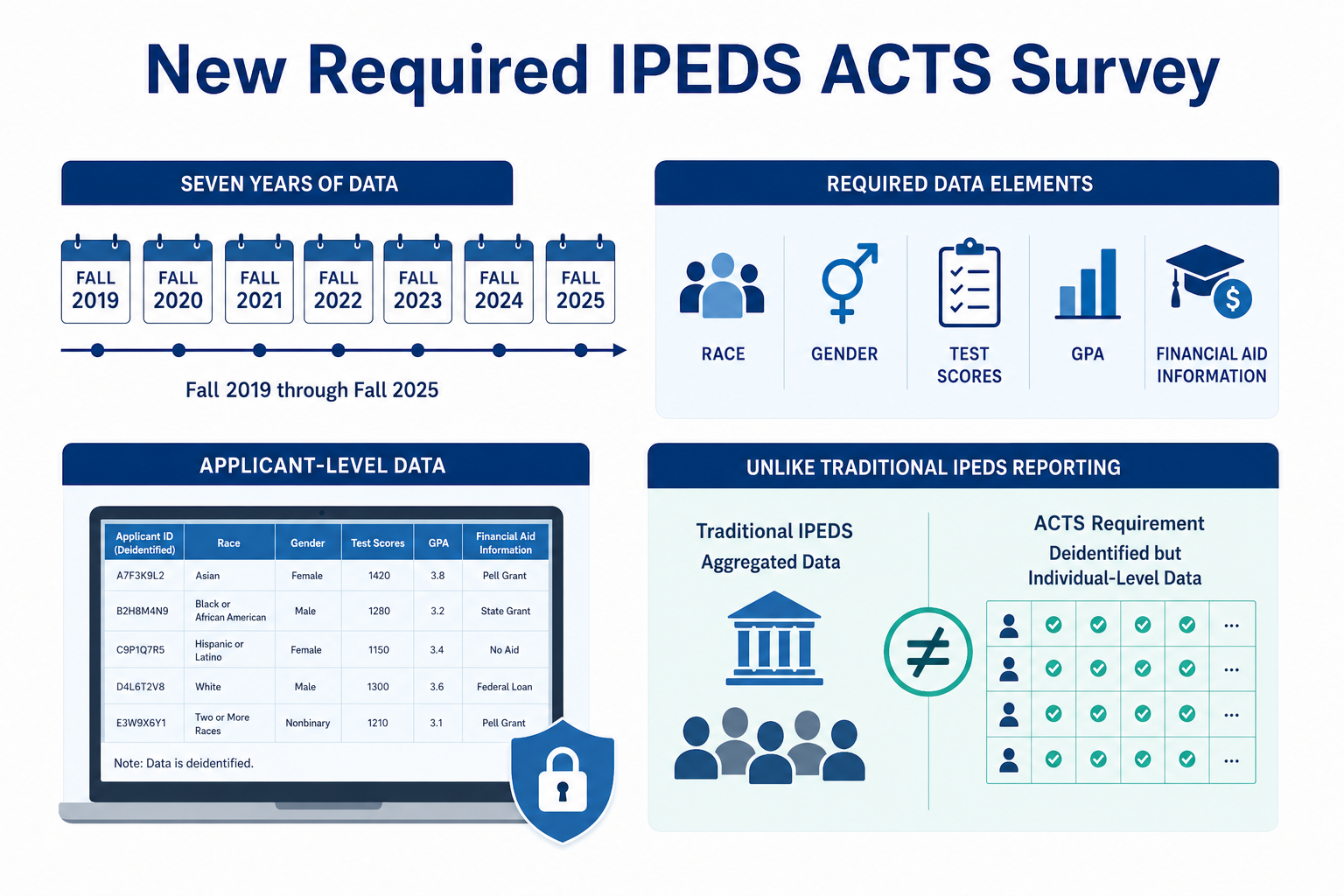
A new federal admissions-reporting mandate, known as the Integrated Postsecondary Education Data System Admissions and Consumer Transparency Supplement (IPEDS ACTS), significantly impacted our office. The requirement was introduced in response to concerns that institutions may still be using race and gender for admissions decisions. ACTS required institutions with admissions standards to submit seven years of applicant-level admissions data (Fall 2019 through Fall 2025) for all first-time undergraduate and graduate applicants. Required data elements included race, gender, test scores, GPA, and financial aid information. Unlike traditional IPEDS reporting, ACTS required information on a deidentified but individual basis.
The challenge was not only the scale and complexity of the request but also the timeline. We had to pause other reporting activities to meet the deadline, with only about three months to produce historical datasets that had never been maintained in the format requested. Our efforts were further compounded by the need to merge information from multiple disconnected systems, reconstruct historical records, and navigate new, untested federal reporting tools. Because UW’s professional programs do not consistently store applicant and test score data in Banner, we relied heavily on colleagues across campus to reconstruct historical information. Harmonizing data across years and systems where definitions and formats were not standardized required a detailed review of each data element to ensure consistency.
The ACTS survey significantly expanded the scope of IPEDS reporting, transforming what is typically a structured annual reporting process into a high-pressure data recovery project. Historically, the Department of Education introduces new reporting requirements through a review and public comment process and provides institutions at least a year to prepare before implementation. ACTS departed from that established approach.
Data quality and methodological validity were also major concerns. Ultimately, IPEDS ACTS placed us in the position of submitting imperfect data under a demanding timeline while reporting requirements continued to evolve. For example, the original guidance required institutions to assign genders to applicants who had not reported one, even though the stated purpose of the collection was to determine whether gender was being considered in admissions decisions. Fortunately, this requirement was removed approximately one month before the reporting deadline.
IPEDS ACTS highlights important issues related to compliance, ethics, privacy, methodological integrity, and political oversight. At the same time, it underscores the need for stronger data governance practices across UW’s data systems to ensure that institutional data can be managed, integrated, and reported effectively in response to future federal requirements.
This blog drew heavily from the following article in the Chronicle of Higher Education: https://www.chronicle.com/article/how-trumps-demand-for-admissions-data-is-burdening-your-college.

The University of Wyoming has earned its Research Level 1 (R1) status from the Carnegie Classification of Institutions of Higher Education, placing Wyoming's only four-year university with the top research universities in the United States.