
Understanding Primary and Secondary Majors
Suzie Waggoner
Published July 06, 2026
5 Minute Read
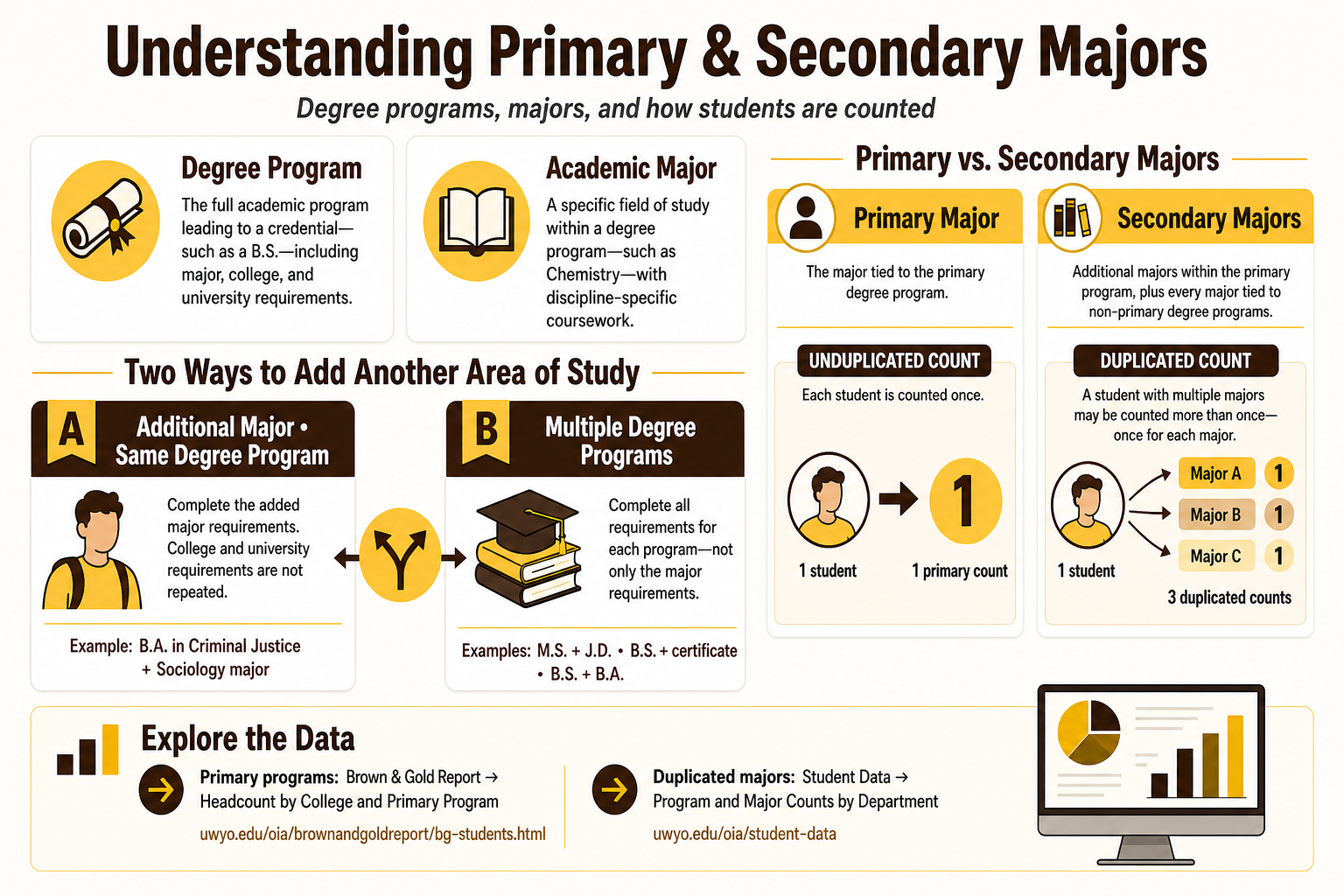
To understand the difference between primary and secondary majors, it is important to first understand the differences between a degree program and an academic major. These terms are often used interchangeably but do have some important distinctions.
A degree program is an academic program of study with minimum and core requirements for the academic major, college, and university that leads to the awarding of a specific degree such as a Bachelor of Science (B.S.) degree. An academic major is a specific field of study within a degree program, such as Chemistry, and includes discipline-specific coursework and requirements.
Students may add additional majors at the same degree level to a degree program. When a student declares a second major under the same degree program, they are required to complete only the additional requirements associated with that major, rather than repeating college or university requirements. For example, a student pursuing a Bachelor of Arts (B.A.) in Criminal Justice degree may also complete a major in Sociology. In this case, the student fulfills all major, college, and university requirements for the B.A. in Criminal Justice program, as well as the requirements specific to the Sociology major.
Students may choose to pursue more than one degree program at the same time. This typically occurs when a student is pursuing two different degree levels with each having its own degree-level requirements. For example, a student working on both a Master of Science (M.S.) and a Juris Doctor (J.D.) or a student working on a B.S. and a certificate. Other reasons multiple degrees may be desired include when degrees are awarded by different colleges or have different degree designations, such as a B.S. and a B.A. Additionally, students whose two majors are not expected to be completed simultaneously may choose to declare separate degree programs. In these cases, all requirements for each degree program, not just the major requirements, must be completed to earn both degrees.
A student's primary major is the major associated with the primary degree program. Unduplicated enrollment counts are based solely on primary majors, ensuring that each student is counted only once. Information on primary programs by college is available through the Brown & Gold Report at https://www.uwyo.edu/oia/brownandgoldreport/bg-students.html. The Headcount by College and Primary Program section can be found at the bottom of the page.
Secondary majors include any additional majors declared within a student’s primary degree program, as well as all majors associated with non-primary degree programs. Duplicated enrollment counts include both primary and secondary majors. As a result, students with multiple majors may be counted more than once, with each major contributing separately to the overall total. Information on duplicated major counts by college and department is available in the Program and Major Counts by Department section near the bottom of the page at https://www.uwyo.edu/oia/student-data/index.html.
Note: this article was created with AI assistance using OIA department information and reviewed by OIA staff.

The University of Wyoming has earned its Research Level 1 (R1) status from the Carnegie Classification of Institutions of Higher Education, placing Wyoming's only four-year university with the top research universities in the United States.