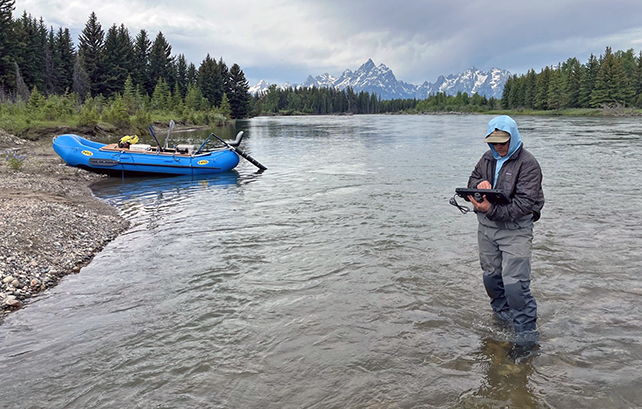
Watershed Focus Snake River
The Upper Snake River is one of three watersheds in Wyoming that the WyACT focuses
on, together with the Wind River and the Green River. They represent the headwaters and upper drainage basins of three major river systems
(Snake-Columbia, Green-Colorado, and Wind-Bighorn-Missouri Rivers).
Just over 1,00 miles long, the Snake River is the largest tributary of the Columbia
River that empties into the Pacific Ocean. It begins in the Wyoming part of Yellowstone
National Park, forms Jackson Lake and continues to Idaho, Oregon and Washington. The
basin serves as a critical case study because it supplies water to ecosystems, communities,
agriculture, recreation, and downstream users throughout the broader Columbia River
system.
WyACT's work in the Snake River basin focused on understanding how changes in snowpack,
streamflow, and broadly ecosystems may affect the region over coming decades. Researchers
combine climate modeling, hydrology, aquatic ecology, economics, and social science
to explore future scenarios.