
WY CAPS Program
University of Wyoming
Dept. Ecosystem Science & Management: 3354
1000 East University Ave.
Laramie, WY 82071
Phone: (307)766-5278
Email: caps@uwyo.edu


Target Pests (National Importance):
Secondary Pests (Wyoming Importance):
Suspect insects are identified at the University of Wyoming and results are submitted to the National Agricultural Pest Information System (NAPIS) database.
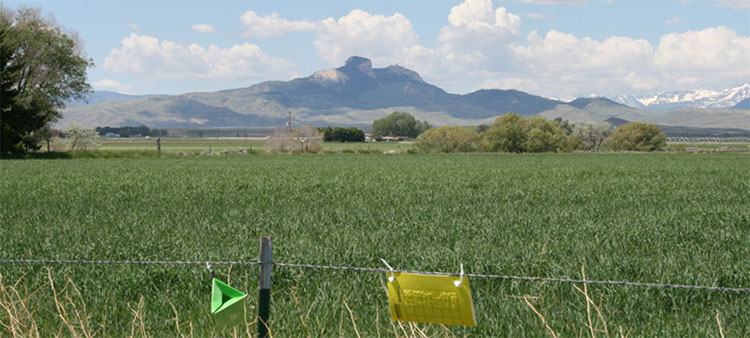
Insect (pheromone) traps will be hung near wheat and barley fields in Platte, Goshen, Laramie, Park, Big Horn, Washakie, Sheridan and Lincoln counties, Wyoming between June and September 2019. Traps are serviced every three weeks and inspected for the target pests (A. gamma, H. armigera, T. leucotreta, S. littoralis, and S. litura).
Between June and September, wheat, barley and corn fields will be visually inspected and also swept for the target and secondary pests (D. speciosa, E. integriceps).
Wheat and barley fields are inspected for signs of black stem rust (Ug99), yellow or striped rust and Urocystis agripyri as part of a focused pathogen survey. Fields are walked, and plants are sampled at random throughout the growing season. Suspect plants are submitted to the University of Wyoming Plant Pathology Laboratory for analysis of plant pathogen signs and symptoms. All data are entered into NAPIS.
Target Pests:
Composite soil samples will be removed from dry bean, potato, and select agricultural fields in eight Wyoming Counties (Park, Big Horn, Washakie, Fremont, Goshen, Platte, Laramie and Sheridan) in the months of September and October, after fall harvest 2019. Soil samples are submitted to the University of Nebraska, Lincoln Nematology Laboratory for identification and confirmation of target pest species. Results are entered into the NAPIS database.
WY CAPS Program
University of Wyoming
Dept. Ecosystem Science & Management: 3354
1000 East University Ave.
Laramie, WY 82071
Phone: (307)766-5278
Email: caps@uwyo.edu