
What to expect from ATV RAATs
Efficacy
This method normally will result in 80 to 95 percent control, which is approximately
5 to 15 percent lower mortality than with a standard (high rate, blanket coverage)
treatment. Leaving low densities of grasshoppers after RAATs does not necessarily
result in a subsequent outbreak (see Environment below).
Economics
Using ATV-RAATs will reduce costs by approximately 70 to 80 percent, depending on
the agent and swath width. For example, if a standard application costs $2.50 per
acre, the equivalent ATV-RAAT program should cost approximately $0.50 to $0.75 per
acre protected. It should be noted that the greatest economic benefits derive from
increased swath spacing since this effectively decreases the costs for both purchasing
insecticides and application.
Environment
RAATs mean 60 to 80 percent less insecticide is applied to our rangelands for grasshopper control. The untreated swaths harbor species essential to rangeland ecosystems, including biocontrol agents of grasshoppers and weeds. Low densities of surviving grasshoppers allow predators and parasites in the untreated refuges to recolonize and thereby reestablish natural regulation of grasshopper populations. For these reasons, RAAT programs also may sustain higher densities of birds than blanket applications.
Application, Calibration, Rate, and Formulation Recommendations
Only emulsifiable formulations of carbaryl, malathion, and diflubenzuron are labeled for grasshopper control on rangeland and all non-cropland areas. At this time, we recommend the maximum label rates be used for these three compounds. Please refer to current labels of these insecticides to ensure safe, effective control.
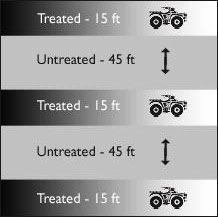
Although our studies have not yet allowed us to fully test and optimize this strategy,
we have sufficient information to provide some recommendations. Our preliminary analyses
indicate that the percent coverage should be equal to the average number of grasshoppers/square-yard
in the infestation, with a minimum of 20% coverage. For example, if you have 30 grasshoppers/square-yard,
then you should use 30% (0.3, as a proportion) coverage. Under these conditions,
if you determine that your spray swath is 15 feet, you will need to spray a swath
every 50 feet (15 feet/0.3 = 50 feet). If you have 40 grasshoppers/square-yard and
your swath is 17 feet you will need to treat a swath every 42.5 feet (17 feet/0.4
= 42.5 feet).
To achieve uniformly spaced swaths you will need to use swath markers, a handheld or mounted geographic positioning system (GPS), compass headings, previous swath tracks, or counted tire rotations on the turns at the ends of swaths. For this latter method, if you want to apply a swath every 42.5 feet, for example, and your ATV tires have a 30-inch circumference, then place a mark on the tire and count 17 rotations between swaths (30 inches x 17 = 510 inches = 42.5 feet). Unlike cultivating a crop, spraying grasshoppers doesn’t require absolute precision. Skips in the pattern to avoid obstacles won’t effect results if the majority of the area is treated at the coverage and rate desired. An advantage with ATV-RAATs is that rocky hill tops and other areas that don’t hold much forage or many grasshoppers can be skipped and additional swaths placed in more heavily infested, productive areas.
ATVs can be hazardous to operate. ATV-sprayers should only be operated by persons at least 18 years old. Always wear recommended safety equipment such as gloves, safety goggles, and a helmet. Be sure to take a training course on the safe operation of your ATV. Drive cautiously, as fully-loaded spray tanks will affect the braking and handling characteristics of an ATV.
Higher rates or coverages may be needed if: 1) treatments are applied to late instar nymphs (if using diflubenzuron), 2) grasshopper densities are extreme, or 3) forage cover is tall or dense. In all cases, grasshopper management software should be used to assess a program. Apply insecticides in accordance with label directions and established guidelines for buffers around water, bees, and human habitations.
For the preceding information in its original brochure form, view it in pdf format.
For a more complete treatment of RAATs, see: Decreasing Economic and Environmental Costs of Grasshopper Control
For more information contact:
Dr. Alexander Latchininsky
Association for Applied Acridology International and
Department of Renewable Resources
University of Wyoming College of Agriculture
P. O. Box 3354
Laramie, WY 82071-3354
(307) 766-2298; latchini@uwyo.edu
Funding for RAAT research has been provided by the state of Wyoming (Legislature, Department of Agriculture, Weed and Pest Districts, University of Wyoming), U.S. Department of Agriculture (Western Regional IPM Project, APHIS, and CSREES), and cooperating industries.

The University of Wyoming has earned its Research Level 1 (R1) status from the Carnegie Classification of Institutions of Higher Education, placing Wyoming's only four-year university with the top research universities in the United States.