
Actions Create Momentum
As coaches, it's easy to focus on goals:
- "Raise my GPA."
- "Get organized."
- "Stop procrastinating."
While these are meaningful aspirations, they don't tell students what to do next. Effective coaching focuses on the next action. Rather than asking, "What's your goal?" consider asking:
- What's one thing you could do before we meet again?
- What's one step that feels realistic this week?
- What action would make the biggest difference right now?
Small actions build confidence. Confidence builds momentum. Momentum helps students continue moving forward.

Momentum and Accountability
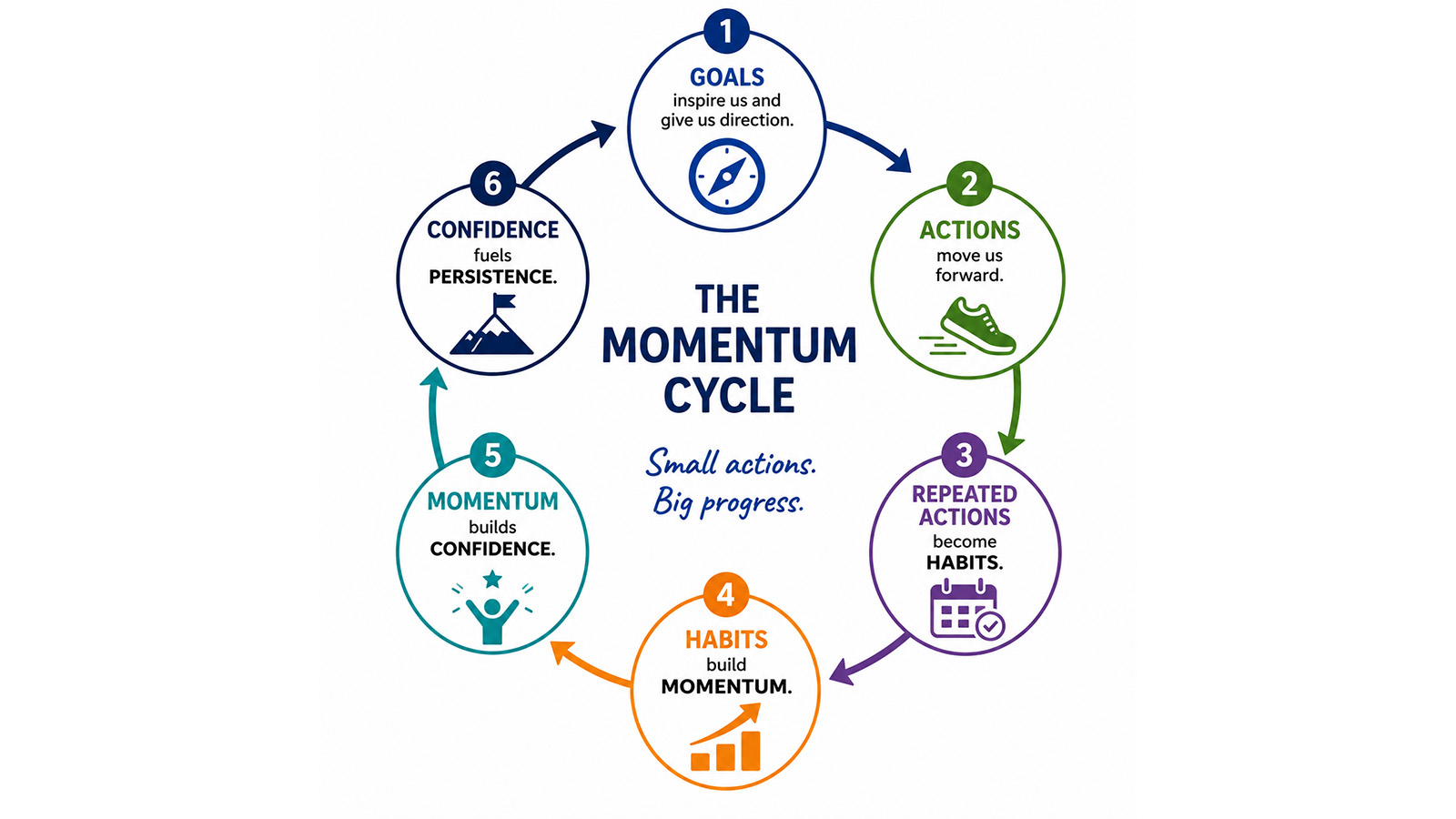
The Momentum Cycle
Goals lead to actions. Actions lead to repeated actions. Repeaded actions lead to habits. Habits build momentum. Momentum builds confidence. Confidence fuels persistence. Persistence helps us make more goals.
Coaching is about helping students move forward one step at a time. We have created a UW Momentum Planner for Academic Life Coaches to utilize with students.
Accountability is About Learning
One of the most valuable parts of coaching is following up. At the beginning of your next conversation, revisit the action your student identified. If they completed it—celebrate the progress. If they didn't—be curious.
Coaching accountability isn't about checking a box or holding students to a promise. It's about helping students learn from their experiences.
Rather than asking:
- "Did you do it?"
Consider asking:
- How did it go?
- What worked well?
- What got in the way?
- What did you learn?
- What would you like to try differently this week?
Sometimes students accomplish their action. Sometimes they don't. Both outcomes provide valuable opportunities for reflection and growth. As an Academic Life Coach, your role is not to help students make perfect plans. Your role is to help them take the next meaningful step—and then encourage them to keep moving forward.

The University of Wyoming has earned its Research Level 1 (R1) status from the Carnegie Classification of Institutions of Higher Education, placing Wyoming's only four-year university with the top research universities in the United States.