
Explore Graduate Studies in Plant Sciences
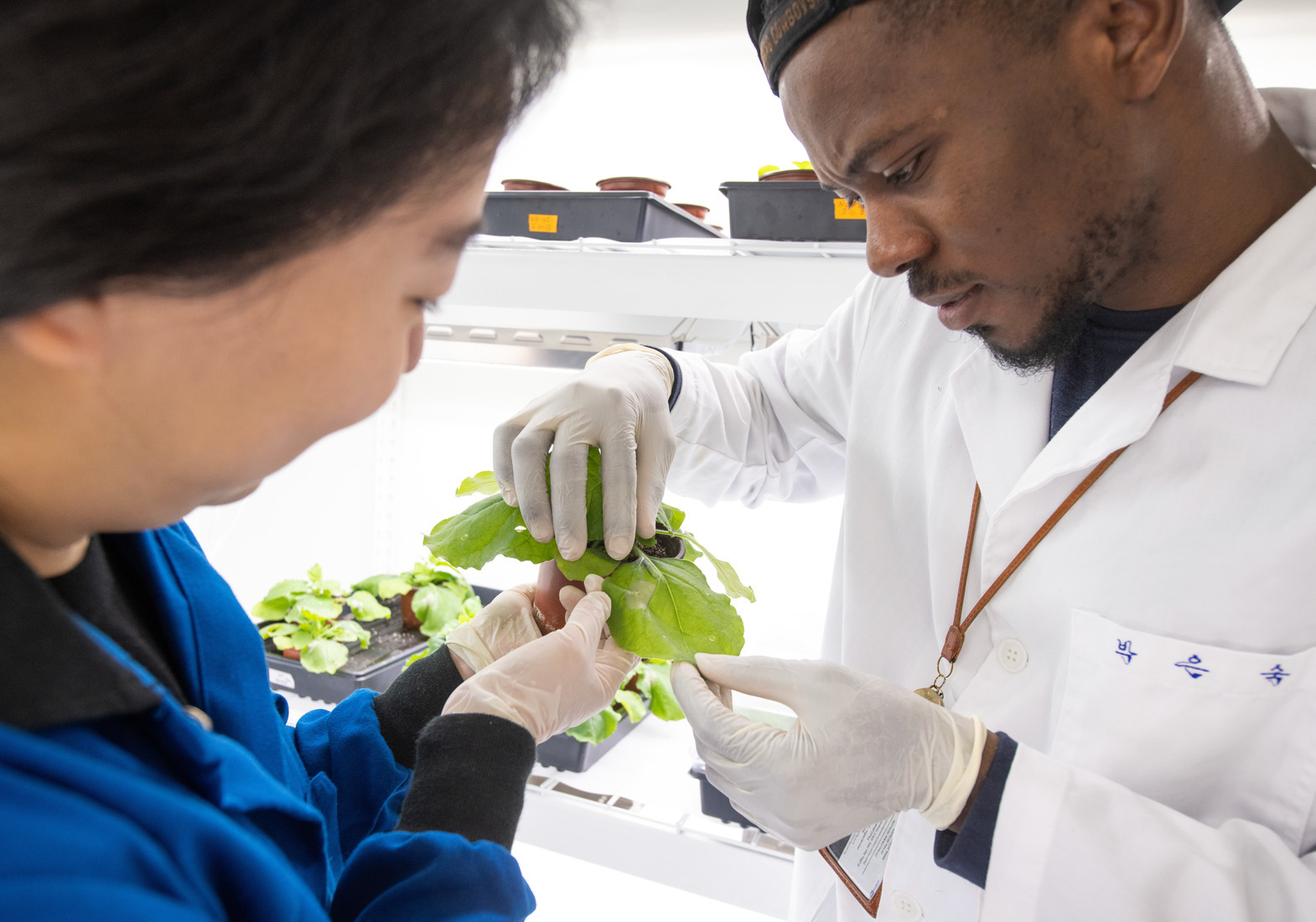
The Department of Plant Sciences offers graduate degrees designed to give students the flexibility to pursue their interests while gaining a broad understanding of sustainable agricultural systems. Students can pursue graduate study in Plant Sciences with opportunities to specialize in areas such as crop science, weed science, agroecology, forage agronomy, plant pathology, horticulture, and specialty crop production. Graduate education is highly individualized, with students working closely with faculty advisors to develop programs of study and research that align with their goals. Through research, teaching, extension, and opportunities to present and publish their work, students gain valuable experience applying scientific knowledge to real-world challenges and communicating their findings to diverse audiences. If you're interested in earning your bachelor's and master's at an accelerated rate, check out our QuickStart Program.
QuickStartGraduate Student Resources
Graduate Student Handbook
The Graduate Student Handbook provides the information, guidelines, and resources you need to navigate your graduate education and succeed in the Department of Plant Sciences.
View HandbookNew Graduate Student Packet
The New Graduate Student Packet provides essential information and resources to help you get started, settle in, and navigate your first steps as a graduate student in Plant Sciences.
Graduate Student Forms
Graduate student forms provide the documents and resources you need to complete important academic, advising, and program requirements throughout your time at UW.
Thesis & Dissertation Guide
Our Thesis & Dissertation Guide provides helpful guidance and resources for planning, preparing, and completing your thesis or dissertation.
QuickStart B.S./M.S. in Plant Sciences
Our QuickStart Program provides students with an accelerated pathway to earn both a bachelor’s and master’s degree. Students can apply after completing their sophomore year and, if accepted, begin planning their M.S. coursework and thesis research while completing their B.S. in Plant Production and Protection or Rangeland Ecology and Watershed Management. The program offers greater flexibility in course planning, allows students to begin graduate-level research early, and can help make more efficient use of their final undergraduate semesters. Up to six credit hours of eligible 5000-level (or 4000-level, when a 5000-level equivalent is unavailable) coursework may count toward both degrees, with additional opportunities to reserve up to six graduate credit hours for the M.S. degree. To be eligible, students must have at least 60 completed credit hours, a minimum 3.0 overall GPA and 3.0 GPA in relevant Plant Sciences courses, at least three letters of recommendation (two from UW faculty), a Plant Sciences faculty member willing to serve as their M.S. advisor, and an approved research proposal. Transfer students must also complete at least 15 credit hours at UW. Students must maintain a minimum 3.0 GPA in both undergraduate and graduate coursework and work with a faculty advisor to develop and file a comprehensive plan of study covering the remainder of their undergraduate and graduate programs.
Admission into the Plant Sciences Graduate Program
The Department of Plant Sciences is always seeking highly qualified applicants for graduate admission. The Department currently offers Master of Science (M.S.) and Doctorate (Ph.D.) degrees in Plant Sciences. Except in rare circumstances, we require an M.S. degree prior to acceptance into the Ph.D. program. We place a high level of emphasis on an applicant's ability to communicate effectively (orally, in writing, and digitally), independent problem solving skills, and the ability to work well as part of a team. The Department has a policy of accepting students only if a faculty member is willing to serve as a mentor; therefore, we strongly encourage you to contact a faculty member within our department to discuss research interests and for information about our program. In addition, please see the M.S. and Ph.D. requirements in the University Catalog.

If you are interested in obtaining a graduate degree from the Department of Plant Sciences, please apply for a M.S. or Ph.D. in Plant Sciences at the University of Wyoming Admissions site (Admissions). You are required to submit the following:
- A statement of purpose that describes your professional objectives and scientific interests
- A current Curriculum Vitae
- Current academic transcripts
- Proof of English Proficiency (if English is not your primary language) - TOEFL, IELTS, or Duolingo tests are currently accepted
- Three letters of recommendation (to be submitted directly by references through the online application)
Our regular deadline for Fall semester admission is February 15, although we will accept applications any time during the year. October 15 is the recommended deadline for a spring admission. Submission of all materials before the deadline will ensure you receive full consideration for admission as well as funding.
Questions about the application process in Plant Sciences should be directed towards your potential academic advisor. Problems with the online application system should be directed to UW Admissions (307-766-5160 option 1, admissions@uwyo.edu).
More information on Graduate Education and the admissions process can be located at the UW Graduate Education website: www.uwyo.edu/uwgrad/ and in the Graduate Student Regulations and Policies entries in the University of Wyoming catalog (UW Catalog).
Teaching assistantships or research assistantships are available as funding allows in the Department of Plant Sciences. Graduate assistantships may be awarded exclusively for teaching or for research, but in most cases a combination of teaching and research will be expected from all students receiving assistantships. With few exceptions, financial support from an assistantship will be limited to two (2) years for the M.S. degree, and three (3) years for the Ph.D. degree. Additional funding may sometimes be provided if degree requirements are not yet met after these time limits; however, additional funding in most cases will be subject to availability of grant funds or other external funding sources. Please discuss these options with your advisor if you think these time limitations will be an issue. All funding is subject to adequate progress toward your degree.

The University of Wyoming has earned its Research Level 1 (R1) status from the Carnegie Classification of Institutions of Higher Education, placing Wyoming's only four-year university with the top research universities in the United States.