
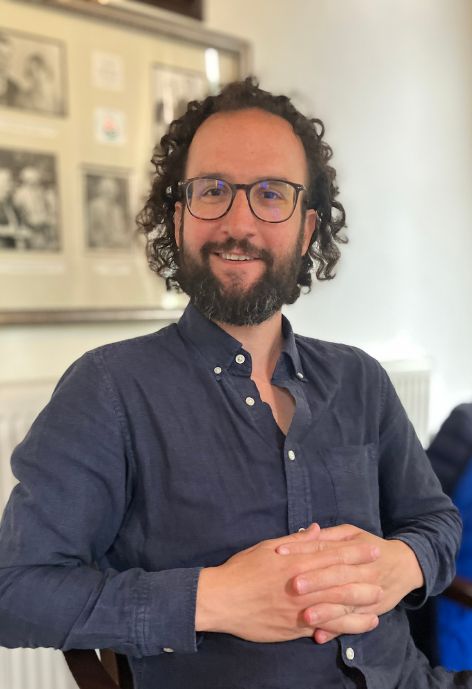
Dr. Nicholas Crane
Associate Professor / INST Undergraduate Program Director
School of Politics, Public Affairs, & International Studies
Academic Areas of Expertise:
Cultural geography; cultural politics; political economy; political geography; social movements; Mexico and the Americas; Turkey and the Middle East
Biography:
Nicholas Jon Crane is an Associate Professor of Geography and International Studies.
He is also the Director of the International Studies undergraduate program in the
School of Politics, Public Affairs, and International Studies.
Crane teaches courses in cultural and political geography, including regional courses
focused on the Americas and the Middle East. Crane’s interest in cultural production
and forms of political engagement in the Middle East emerged from his family life,
as the son of an immigrant from Turkey and a US-born specialist in Islamic art and
architecture. Crane became more concretely interested in politics (lowercase-p politics)
by participating in community-based projects in his hometown, Columbus, Ohio. These
experiences inspired travel to Mexico City in 2009, where he developed a research
idea that would help him return to central Mexico twice per year while he completed
his PhD in Geography at Ohio State (2014). Crane remains well connected with colleagues
and communities in central Mexico and, initially with support as a Seibold Professor
in the College of Arts & Sciences in 2023-23, he has also been cultivating and maintaining
connections with academics and practitioners in the Aegean region of Turkey, centered
on Izmir. In both regions (central Mexico and Aegean Turkey), Crane has been interested
in a wide range of cultural-political and political-economic processes of urban transformation
and popular mobilization. Crane's courses at UW not only help students become proficient
in academic fields of study like cultural geography, cultural studies, political geography,
and so on; the courses are also informed by his experiences across this trajectory,
which — for students — serve as points of reference for thinking about how these academic
fields of study are relevant to practices of global engagement, broadly thought.
In his research life, Crane is mostly focused on two agendas:
- Mixed-methods, collaborative research on violence, urbanization, and social mobilization in central Mexico – the Mexico City megalopolis
- Mixed-methods research on the politics of urban transformation in Turkey, especially in the Aegean region, centered on İzmir
Crane's work in central Mexico has continued in the years since his field research
for his PhD, mostly through collaboration with Oliver Hernández Lara (Universidad
Autónoma del Estado de México) and David Tapia Martínez (Benemérita Universidad Autónoma
de Puebla). As part of this research team, Crane is writing and publishing in both
English and Spanish. Crane's collaboration with Hernández Lara and Tapia Martínez
has generated many publications in recent years, on a variety of themes, including
place-based protest art (in Human Geography), "metabolic exchange" in peripheralized regions of the Mexico City megalopolis (in Journal of Latin American Geography), and landscape as a technology of sovereign power (in Bajo el Volcán). This collaborative work is ongoing.
Crane began contributing to the interdisciplinary field of Turkish Studies more recently.
Consistent with some prominent themes in that interdisciplinary field of study (state
formation, popular mobilization, the cultural politics of nationhood, and so on),
Crane has been interested to think across contexts of state-backed urbanization to
consider how multiple forms of violence may be made unaccountable, or naturalized,
through transformations and representations of place. Some of Crane's efforts in this
direction are captured in his editorial work for a special issue of the journal Justice, Power and Resistance on "Violence and Urban Transformation in Contemporary Turkey," guest edited with
Çağlar Dölek (Cal Poly Humboldt).
By way of and beyond these research agendas, Crane has for many years published widely
in top ranking journals and high-profile edited collections. His publications deal
with a range of themes including the forms and practices of contemporary social movements,
the spatiality of sovereign power, transformations of peri-urban landscapes, place-based
memories of political violence, and methodologies of cultural and political geography.
Crane is an editorial board member for two academic research journals in Turkey — Yeni Medya/New Media and Türk Coğrafya Dergisi/Turkish Geographical Review. Since 2018, Crane has also been the section editor for political geography in the
journal Geography Compass.

The University of Wyoming has earned its Research Level 1 (R1) status from the Carnegie Classification of Institutions of Higher Education, placing Wyoming's only four-year university with the top research universities in the United States.