
Image-based High-Fidelity Modeling at Material Microscale
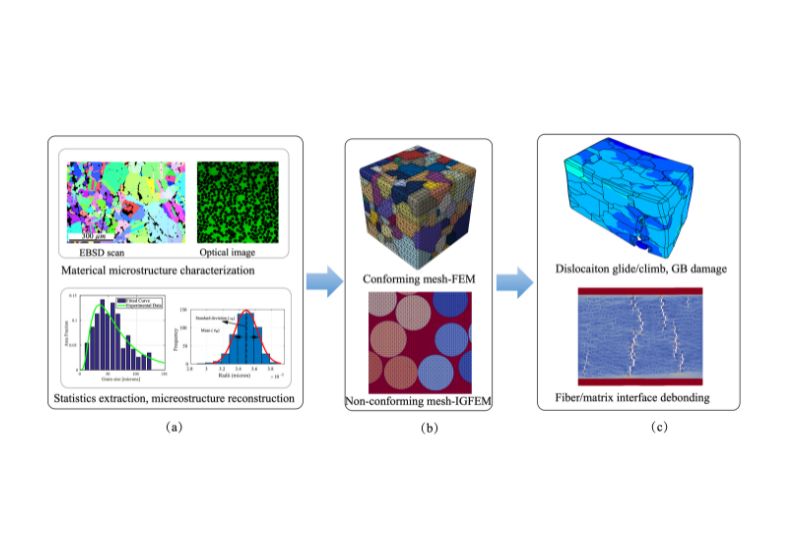
Computational modeling at the material microstructural scale, which relies on fully resolved microstructure, and physics-based constitutive modeling, can provide fundamental understanding of the deformation and failure mechanisms at material microscale, facilitating material selection and design for engineering applications. We aims at developing an integrated microstructure reconstruction and physics-based modeling work flow as shown in the figure above to study various advanced materials. Current research includes Crystal Plasticity Finite Element) modeling of high-performance alloys [1, 2, 3], and Interface-enriched Generalized Finite Element Method) for transverse failure response modeling of fiber-reinforced composites [4].
When integrated with sensitivity analysis (e.g. sensitivity of stress-strain response with respect with microscale material/shape parameter), we can achieve microstructure design to achieve desired properties.
Reduced-Order Multiscale Modeling and Design
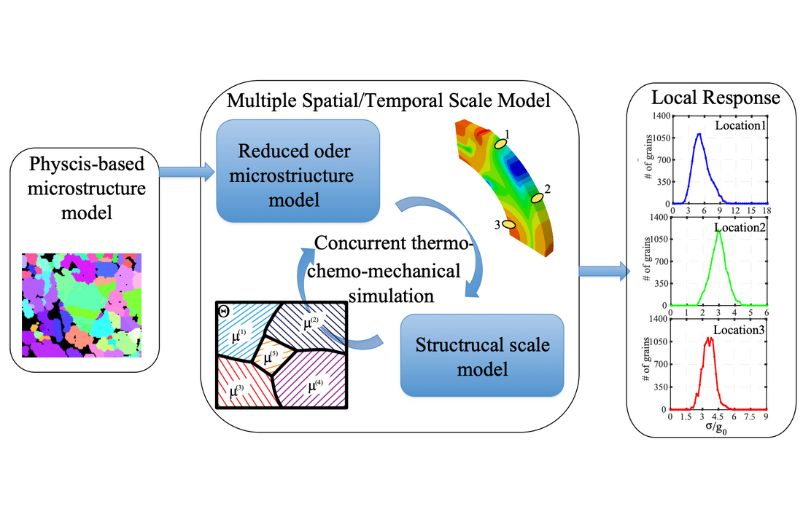
While tremendous progress has been made in microstructure-based and physics-informed microscale modeling, the real world design has not yet benefited as much as they could from these simulations, mainly due to the prohibitive computations cost associated with briding microscale response (e.g., at the order of micrometers) to that of structural scale (e.g., at the scale of centimeter or even meters).
To address this issue, we focus on developing reduced-order models that use pre-calculated information as well as approximated spatial variance of the microscale response, to formulate a reduced-order system that replaces the expensive microscale problem in a concurrent multiscale modeling framework (5, 6).
This model also features a hierarchical model improvement capability that delivers a series of increasingly refined model with increased computational cost, that eventually recovers the full filed microscale mode. Integrated with sensitivity analysis, it also allows to conduct reduced-order sensitivity analysis and material design.
Multiphysics Modeling of Composite Manufacturing
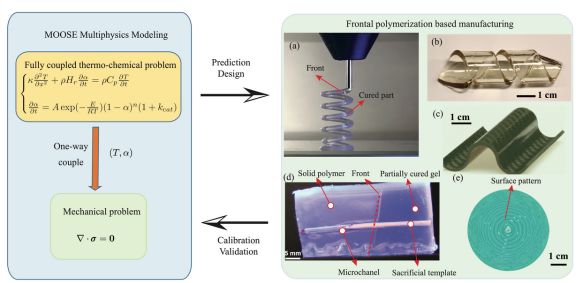
The ultimate goal of material modeling and design is to be able to inform the manufacturing process, such that we are able to design the relevant parameters associate with manufacturing that produces a certain microstructure that eventually deliver desired performance at the structural scale. To establish the link between processing and microstructure and properties at the microscale, both multiscale and multiphysics modeling technique are needed. To achieve this goad, we are actively working on modeling the chemo-thermo-mechanical process associated with composite manufacturing [7] and metal additive manufacturing.

The University of Wyoming has earned its Research Level 1 (R1) status from the Carnegie Classification of Institutions of Higher Education, placing Wyoming's only four-year university with the top research universities in the United States.