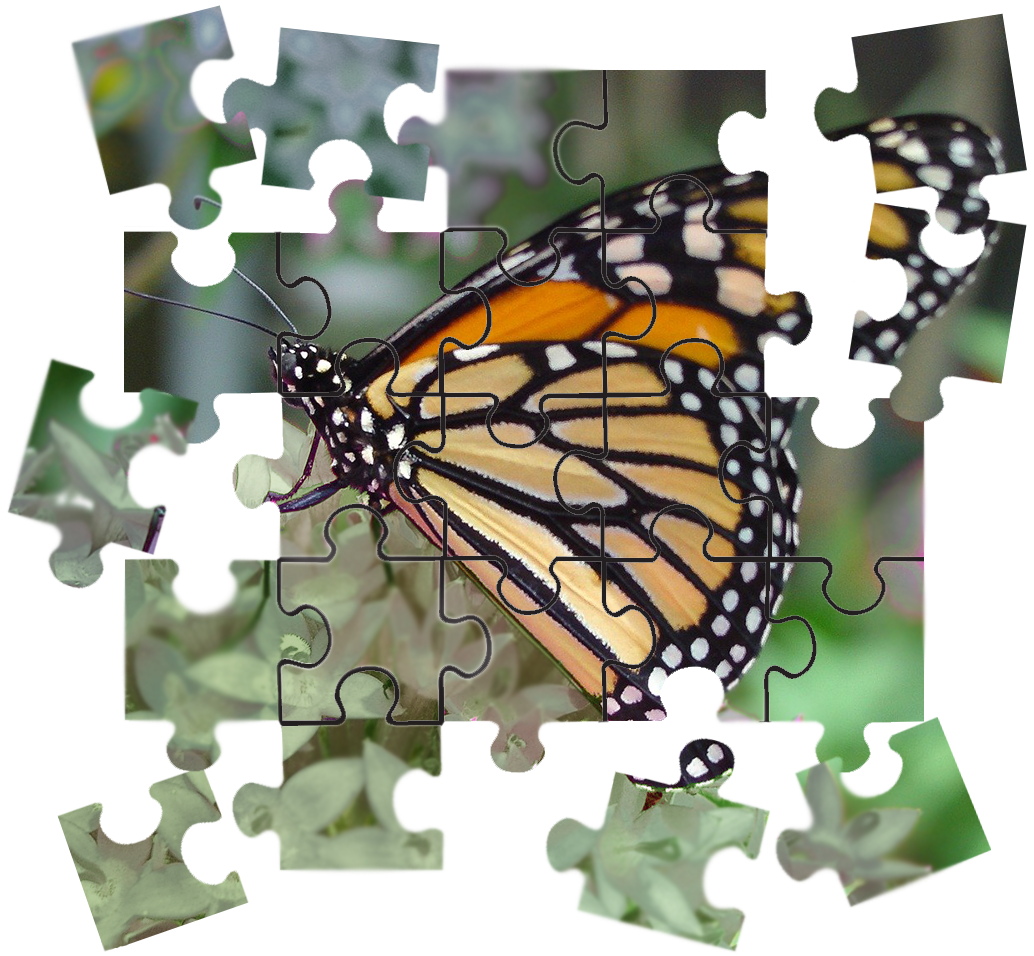
Why are butterflies declining? A look at monarchs and the insect apocalypse
Elise Zipkin, Red Cedar Distinguished Professor in the Department of Integrative Biology at Michigan State University
Published July 03, 2025
6 Minute Read
2025 Harlow Summer Seminar Series: July 3rd
Talk Title: Why are butterflies declining? A look at monarchs and the insect apocalypse
Speakers: Elise Zipkin, Red Cedar Distinguished Professor in the Department of Integrative
Biology at Michigan State University
We will host a BBQ at 5:30 followed by the seminar at 6:30, with a $10.00 suggested donation for attending the event. The event is open to the public and reservations are not required.
Attend Virtually: The talk will also be live on Zoom. The zoom link will be made available through our email list. If you haven’t already, join our mailing list!
Abstract
Numerous declines have been documented across insect groups, and the potential consequences of insect losses are dire. Butterflies are the most surveyed insect taxa, yet analyses have been limited in geographic scale or rely on data from a single monitoring program. Using records of 12.6 million individual butterflies from >76,000 surveys across 35 monitoring programs, our team characterized overall and species-specific butterfly abundance trends across the contiguous United States. Between 2000 and 2020, total butterfly abundance fell by 22% across the 554 recorded species. Species-level declines were widespread, with thirteen times as many species declining as increasing. This talk will discuss butterfly trends across the continental U.S. and dive into more specific trends of monarch butterflies, including possible drivers of decline.
The prevalence of declines throughout the U.S. highlights an urgent need to protect butterflies from further losses.
Bio
 As a quantitative ecologist, Dr. Elise Zipkin connects the complexities of natural
communities with the precision of mathematics to shine light on mysteries in ecology
and conservation. Elise and her team develop analytical frameworks to address grand
challenges in the study of biodiversity loss and the effects of anthropogenic activities,
such as climate change. She harnesses empirical data (big and small) to understand
fine and subtle interactions in the natural world, revealing the causes and consequences
of species’ declines and biodiversity loss while charting pathways to mitigate and
reverse these alarming trends.
As a quantitative ecologist, Dr. Elise Zipkin connects the complexities of natural
communities with the precision of mathematics to shine light on mysteries in ecology
and conservation. Elise and her team develop analytical frameworks to address grand
challenges in the study of biodiversity loss and the effects of anthropogenic activities,
such as climate change. She harnesses empirical data (big and small) to understand
fine and subtle interactions in the natural world, revealing the causes and consequences
of species’ declines and biodiversity loss while charting pathways to mitigate and
reverse these alarming trends.
Elise has published over 100 peer-reviewed articles and delivered more than 50 invited talks nationally and internationally. Among her honors is being named a Fulbright U.S. Senior Scholar, an International Ecology Institute (ECI) IPRE Laureate, and an Ecological Society of America Early Career Fellow. Elise regularly works with management agencies to translate the results of her research for conservation. She is committed to open, accessible, and reproducible science and to supporting and mentoring the next generation of scientists, natural resource managers, policy makers, and scientific communicators.
Contact Us
E-mail: uwnps@uwyo.edu
Staff-specific contact information can be found here.
UW-NPS Research Station at the AMK Ranch
Open June through September
Mailing Address for letters (Checked weekly during summer season)
UW-NPS Research StationPO Box 170
Moran, WY 83013-0170
Address for shipping packages via Fed-Ex:
Let us know when shipping packages as sometimes they are delivered to the PO Box instead of the Station.
c/o UW-NPS Research Station, Grand Teton National Park1 AMK Ranch Road
Moran, WY 83013-0170
Research and Economic Development Division
Old Main
Room 308
1000 E. University Ave
Laramie, WY 82071
Laramie Address
Open year-round
UW-NPS Research
Box 3166
1000 E. University Ave.
Laramie, WY 82071
Connect: