
Forms for Caps
Faculty start the course process by utilizing a CAP Initiation Form. These forms can
be digital (Qualtrics) or the .PDF. This will be a choice between the faculty member
and the Originator.
Faculty need to fill these out fully before giving them to Originators. Any questions
about missing information on the worksheets please follow up with that faculty member.
Curriclulum Software for Originators
Faculty Course Polcies and Procedures
The Course Approval Process (UW SAP 2-119.2) outlines the procedures for course approvals. Faculty with academic questions may contact their respective University Course Review Committee (UCRC) representative.
Because course changes require updates in two systems, the process can be complex and time-consuming. Originators are strongly discouraged from submitting CAPs at the last minute. To allow sufficient time for review, processing, and approval, please submit CAPs as early as possible and ensure all information is complete and accurate.
Departments, colleges/schools, Academic Affairs, and the UW Board of Trustees each have established timelines for reviewing and approving Curriculum Action Proposals (CAPs). Contact the appropriate department or office for clarification regarding specific deadlines.
To be included in the next academic year's catalog, all course CAPs must reach the University Course Review Committee (UCRC) approval step before the committee's first November meeting. Specific meeting dates and deadlines are available on the University Course Review Committee webpage.
The current University Studies Program (USP) 2015 requirements remain in effect under UW Regulation 2-105. Efforts to transition to the Next Generation General Education requirements are currently paused.
Colleges may review and approve USP course designations at the college level, with the exception of Communications (COM 1, COM 2, and COM 3), which must be reviewed and approved by the USP Committee. All additions or removals of USP designations must be submitted through a Curriculum Action Proposal (CAP) for each course.
Required Documentation: CAP submissions requesting a USP designation or a change to an existing designation must include the appropriate application form. Forms are available on the UW USP website:
- U.S. and Wyoming Constitutions (V): V Course Approval Form
- Quantitative Reasoning (Q): Q Course Approval Form
- Human Culture (H): H Course Approval Form
- Physical and Natural World (PN): PN Course Approval Form
- Communications (COM 1, COM 2, and COM 3): COM 2 Course Approval Form and COM 3 Course Approval Form.
Approval documentation for college-level designations (V, Q, H, and PN) must be uploaded with the CAP submission. Communications designations require USP Committee approval.
All new course and course modification CAPs must include the course syllabus. For course modifications, both the current and proposed syllabi must be submitted to facilitate review of the changes.
Academic Affairs oversees syllabus requirements, while departments maintain syllabi for student and faculty access. An official syllabus template is available from Academic Affairs for reference.
Submit a single CAP for both courses in a dual-listed arrangement and include one syllabus identifying both course numbers. Example: AAST 4065/AAST 5065.
The syllabus must clearly distinguish the expectations, assignments, and level of rigor required for graduate students enrolled in the 5000-level course. Graduate-level coursework should reflect approximately 20% more work than the corresponding undergraduate course.
A CAP must be submitted for each new course in a cross-listed arrangement to ensure that each course is created and included in the catalog. If an existing course is being cross-listed with a new course, submit a CAP to modify the existing course and a separate CAP to create the new course. Both CAPs must identify the cross-listing relationship between the courses.
A single syllabus must be provided that lists all cross-listed courses. Although the courses may be taught by different departments, they must cover the same course content and learning outcomes.
Example: AAST 4065 / NAIS 4065 / POLS 4068
UW Regulation 2-100 (Academic Planning and Course Management) governs academic course management. Although both prerequisites and registration restrictions may affect a student's ability to register for a course, they serve different purposes.
- Prerequisites are academic requirements that students must meet before enrolling in a course. Examples include completing specific courses, earning required letter grades, or achieving designated test scores.
- Registration restrictions limit enrollment based on criteria such as major, class level, department, or course attributes.
Upper-division courses (3000- and 4000-level) are designed primarily for juniors and seniors and should build on knowledge and skills developed in lower-division coursework. As such, these courses should include at least one prerequisite. However, a single prerequisite may be appropriate when a sequence of earlier prerequisites provides the necessary preparation.
3000- and 4000-level courses should build on concepts, techniques, and skills learned in lower-division courses by introducing advanced concepts, requiring well-developed analytical skills, or encouraging students to synthesize information and create new work.
4000-level courses should have a relatively deep and focused subject area that prepares students for graduate study or entry into the workforce.
A letter grade of D is considered passing for prerequisite purposes, unless a specific course requirement establishes a higher minimum grade.
Please make course descriptions 50 words or less.
The course description used in a CAP must match the course description in the syllabus.
|
Undergraduate and graduate courses are classified into one of two instruction categories: Group 1 (Group Instruction) or Group 2 (Individualized Instruction).
Group 1 – Group Instruction: Lecture, laboratory, discussion, seminar, recitation, and studio.
Group 2 – Individualized Instruction: Lesson, internship, readings, clerkship, practicum, independent study, independent research, thesis research, dissertation research, and continuing registration.
|
Creating a New Course Number
Contact the Office of the Registrar to ensure the new course number has not been used at UW in the past.
In cooperation with Wyoming Community Colleges, a numbering protocol was established and can be found on the CCNS web page.
Creating a new Prefix
Prefixes can be created at any time, by any college/school and must be between 2-4
letters in length. (e.g. ES, CHEM) They should be representative of the courses
being taught. Departments are responsible for creating or discontinuing prefixes.
Email the Registrar with desired course prefix changes.
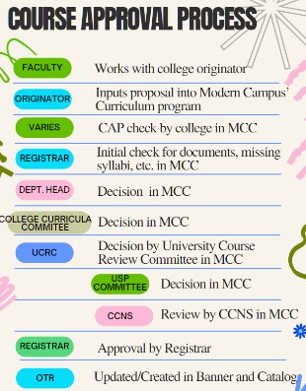
Curriculum follows an approve-or-reject decision process at each approval step. An Approve decision allows the CAP to move forward in the approval process. A Reject decision indicates that corrections, additions, or other issues must be addressed before the CAP can proceed. Originators can make the necessary revisions and resubmit the CAP for approval.
The Comments section allows reviewers at each approval step to document feedback, concerns, or requested changes to accompany their decision.
Curriculum sends email notifications when a CAP advances through the approval process or is returned for revisions. These notifications help keep Originators informed of the CAP's status as it progresses toward completion.
To discontinue a course, submit a CAP for the course. If discontinuing 10 or more courses, you may submit a single CAP and attach a file listing all courses to be discontinued.
Lower-Division Courses: Follow the UW CCNS numbering protocol. Courses at least 70% similar in content to a Wyoming community college course must align in prefix, number, and title per Wyo. Stat. § 21-18-202(a)(vi).
Course Titles: Terms such as Intro or Introduction to may create CCNS conflicts for 1000- and 2000-level courses.
Upper-Division Courses: Titles must not duplicate those of lower-division courses offered by Wyoming community colleges. Use distinguishing terms such as Advanced, Intermediate, or Senior.
Instructional time and student workload must be equivalent to in-person delivery and align with the course’s designated credit hours. See the Credit Hour Definition.
Describe how instructional time is achieved (e.g., recorded lectures, readings, or interactive modules), particularly for courses offered in a condensed timeframe.
Clearly define student workload expectations, including the time required to complete coursework, especially in a condensed timeframe.

The University of Wyoming has earned its Research Level 1 (R1) status from the Carnegie Classification of Institutions of Higher Education, placing Wyoming's only four-year university with the top research universities in the United States.