
 Preliminary results have been presented to the Wyoming Computing Symposium in the
Fall of 2025. The second seed grant ($5,000) has supported the Shoemaker lab (BOT),
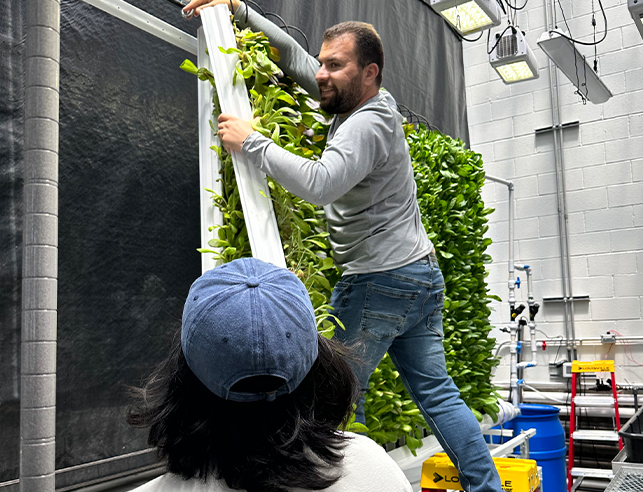
whose project asked how crop diversity and watering intensity affect plant performance
for different food crops—romaine, radishes, and everbearing strawberries. Preliminary
results suggest that the benefits of intercropping do emerge in CEA settings but are
species dependent with potential tradeoffs among species. The CEA grant supported
a postdoctoral researcher, Courtenay Ray, an undergraduate researcher, Kailynn Johnson.
Preliminary results have been presented to the Wyoming Computing Symposium in the
Fall of 2025. The second seed grant ($5,000) has supported the Shoemaker lab (BOT),
whose project asked how crop diversity and watering intensity affect plant performance
for different food crops—romaine, radishes, and everbearing strawberries. Preliminary
results suggest that the benefits of intercropping do emerge in CEA settings but are
species dependent with potential tradeoffs among species. The CEA grant supported
a postdoctoral researcher, Courtenay Ray, an undergraduate researcher, Kailynn Johnson.
So far, the C-CEA has awarded two graduate student fellowships. The first in 2023 to Michael Elgin, a PhD student in Computer Science, and the second
in 2024 to Menuka Jayalath, a PhD student in Civil Engineering. Through his fellowship,
Michael Elgin is establishing the foundations of UPD-3D (unsolvable problem detection)
research with direct applications in CEA. His tool addresses a key bottleneck in Crops3D
experiments, the absence of inherent textual annotations, by generating descriptive
text for otherwise unlabeled point clouds. Through her fellowship, Menuka Jayalath
is exploring strategies to enhance the sustainability of indoor agriculture, including
the development of a consistent framework for applying life cycle assessment to CEA,
evaluating opportunities for energy optimization and renewable integration, and assessing
approaches for water and nutrient recycling. Lastly, another student, Romy Agrawal,
will be able to continue his work on phenotyping and machine learning completing his
MS with the support of the center starting in 2026.
For more information about current research in CEA, visit: https://www.uwyo.edu/science-initiative/plant-facility/research-at-the-pgfc.html

The University of Wyoming has earned its Research Level 1 (R1) status from the Carnegie Classification of Institutions of Higher Education, placing Wyoming's only four-year university with the top research universities in the United States.