
Aven Nelson
The University of Wyoming Libraries trace their origins to 1887, the same year the university was founded. A gift from Charles E. Clay of Rock Creek, Wyoming in the form of a 300 book donation established the institution’s first library. The small collection was housed in the University Building, now known as Old Main. Aven Nelson, a biology professor, was appointed the first Librarian, beginning a legacy of stewardship that would guide the Library into the future.
In the years that followed, the Library grew steadily in both size and significance. Professor Justus F. Soule, who succeeded Nelson in 1889 as the second Librarian, introduced the Dewey Decimal Classification system, laying the groundwork for modern cataloging practices. Dr. Grace Raymond Hebard, appointed as the third Librarian in 1894, oversaw a period of steady expansion. After managing the collection while also serving as secretary to the Board of Trustees, Dr. Hebard resigned in 1919 to dedicate her career to teaching Wyoming history. In 1922, the Library designated the Hebard Room to honor Grace Raymond Hebard and her deep commitment to documenting Wyoming and the West.[1] After Hebard’s death in 1936, her extensive collection of books, manuscripts, and artifacts enriched this special collection. These materials now comprise the modern Hebard Collection within the Libraries and the American Heritage Center.
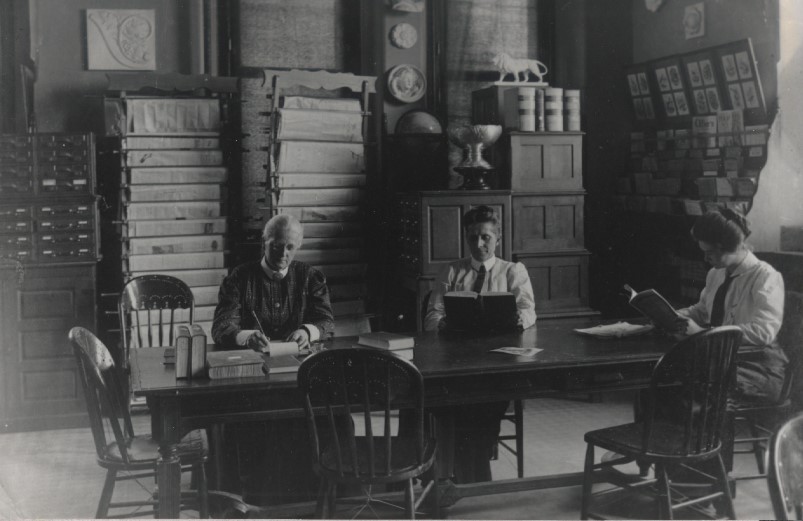
The Library received its first formal acquisition budget of $1,400 in 1897, marking a shift from reliance on donations and student fees to institutional support. As the collection expanded, space quickly became a challenge. In 1904, the growing number of materials soon required relocation to the first floor of the Main Hall due to the books' weight. During that time, the Library also adopted a card catalog system to replace the earlier handwritten records. Three years later, the Library was designated a federal depository library, ensuring access to government publications that supported research and civic education. By 1917, the collection included over 17,000 volumes and subscriptions to more than 200 periodicals, reflecting the university’s academic growth and the increasing diversity of its programs.
By the late 1910s and onwards, however, the limits of the University Building were undeniable.[2] Reba Davis, appointed the university’s first full-time Librarian in 1919, envisioned a dedicated library building.[3] In 1921, Aven Nelson himself led a student delegation to Cheyenne and chartered a train so students could lobby directly to the state legislature for funding. Their efforts succeeded, and in 1923, the new building opened its doors, providing a new home for the Library and leading the way into the institution's next era.[4]
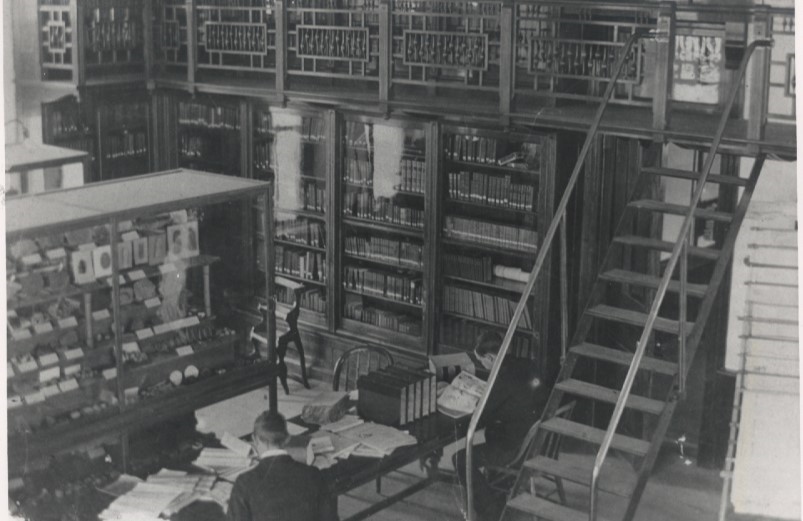
Justus F. Soule
Grace Raymond Hebard


The University of Wyoming has earned its Research Level 1 (R1) status from the Carnegie
Classification of Institutions of Higher Education, placing Wyoming's only four-year
university among the top research universities in the United States.
The University of Wyoming Libraries has been a Federal Depository Library since 1907. The collection comprises approximately 1.5 million print and microfiche
items in Coe Library and Library Annex, as well as maps, aerial and infrared photographs,
and geological publications housed in the Brinkerhoff Geology Library. The Federal
Document Library Program is changing from physical to digital distribution of government
information; UW Libraries provides access to online publications available from the
Federal Depository Library Program through the library catalog.