
Grant Bowman, Ph.D.
Associate Professor
Department of Molecular Biology

Dr. Bowman received his bachelor’s degree in Cell and Developmental Biology from the University of Rochester in 1997 and his PhD in Molecular Genetics and Cell Biology from the University of Chicago in 2004. After several postdoctoral studies at Stanford University, Dr. Bowman joined the faculty in the Molecular Biology Department at the University of Wyoming in 2012.
Research in the Bowman laboratory can be separated into the categories of basic science and applied bioengineering, but both are united by the common theme of subcellular organization. The basic science part of the lab is primarily focused on membraneless microcompartments that form at the cell poles of bacteria and are points of concentration for key developmental regulators, including those that are responsible for controlling the cell cycle, chromosome segregation, and developmental switches that underlie asymmetric cell division. These investigations seek to understand how multiprotein pathways are concentrated within polar microdomains and why this beneficial to the cell physiology.
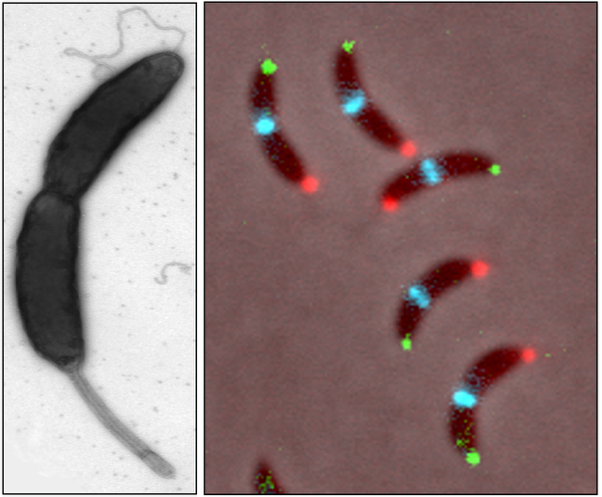
Cryo-electron microscope (left) and 3-color fluorescence microscope image (right) of Caulobacter crescentus, a polarized bacterium that divides into two distinct cell types, leveraging polar asymmetry to achieve multicellularity.
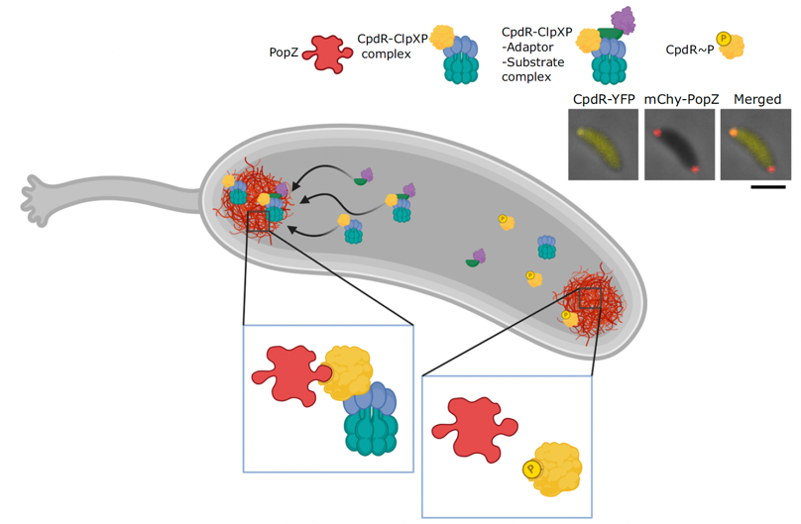
In its exploration of the mechanisms that underly polar asymmetry, the Bowman lab has shown that an adaptor protein for targeted proteolysis (CpdR) is asymmetrically localized on the basis of its phosphorylation state, which determines its ability to interact with the polar assembly protein PopZ. (DOI: 10.1038/s41467-024-53395-y)
The applied bioengineering side of the laboratory uses our growing knowledge of polar organization in natural organisms to create genetically engineered microbes in which in cell differentiation and multicellularity can be controlled by human inputs. Here, genetic engineering is used to modify and enhance cell organization components found in natural systems, for the purpose of transforming normal cells into microbial factories with superior biomanufacturing capabilities. In one embodiment, a polar organizing protein is modified for the purpose of establishing two different cell types: a factory cell that expends its metabolic resources in making product and a regenerative stem cell that continually makes new factory cells (DOI: 10.1038/s41589-019-0340-4). This stem cell – factory cell strategy addresses a general limitation of conventional biomanufacturing, which is that highly productive cells experience heavy biosynthetic burden and rapidly lose productive capacity, and is particularly useful when applied toward the production of toxic products.
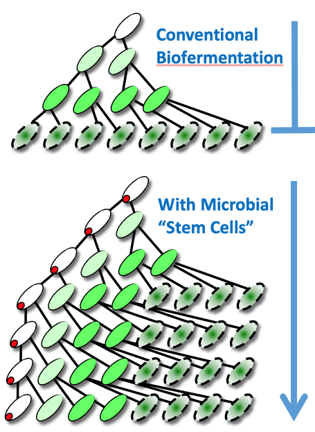
Stem cells (marked by red dots) support the continued production of biosynthetically active factory cells, which can be particularly advantageous if older factory cells die or become exhausted due to biosynthetic burden.

In this time-lapse image series, a stem cell (red) divides into one renewed stem cell and one cell that differentiates into a factory for a cytotoxic product (green).
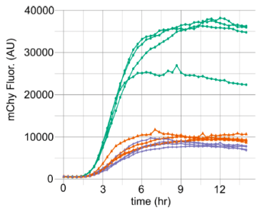
Stem cell supported E. coli cultures produce several fold more toxic product than factory cell-only control cultures.

The University of Wyoming has earned its Research Level 1 (R1) status from the Carnegie Classification of Institutions of Higher Education, placing Wyoming's only four-year university with the top research universities in the United States.