
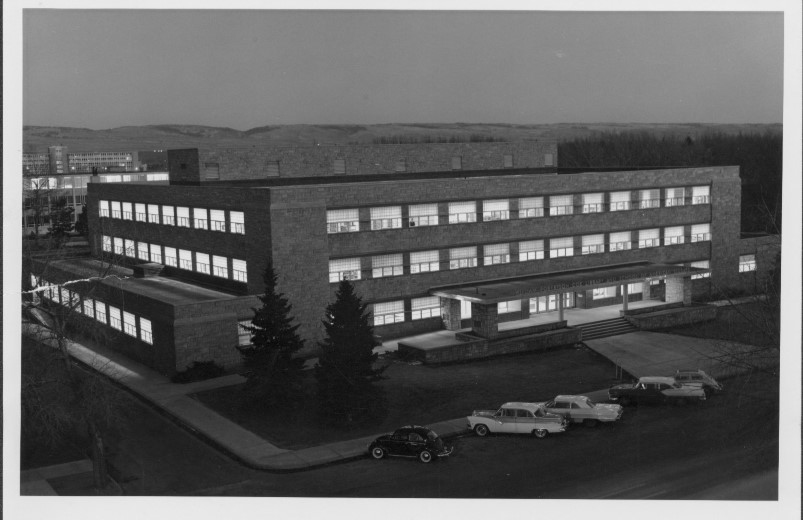
The opening of the four-story William Robertson Coe Library in 1958 marked a historic moment for the University of Wyoming.[1] After two years of construction, students, faculty, and staff transferred 260,000 volumes and more than half a million documents, maps, and other materials from the old Library Building and various storage locations across campus. When the new facility opened just before the fall semester, it immediately reshaped academic life. As many as 530 readers used the building at once, triple the capacity of its predecessor, and circulation statistics rose by twenty percent in the first year alone.
Although William R. Coe had passed away three years before the library’s dedication, his influence and generosity were crucial to the day’s ceremonies. Trustee Cliff Hanson reminded attendees that Coe’s philanthropy was driven by his belief in academic freedom, intellectual vigor, and the importance of preparing American citizens to meet global challenges in an age overshadowed by the Cold War. Coe saw the library, as well as the American Studies program it housed, as instruments through which young people might gain knowledge and become thoughtful participants in public life. As Hanson concluded, “No building on campus can play a more decisive role in our future than this one,” a testament to Coe’s conviction that education and open inquiry were essential to the nation’s resilience.
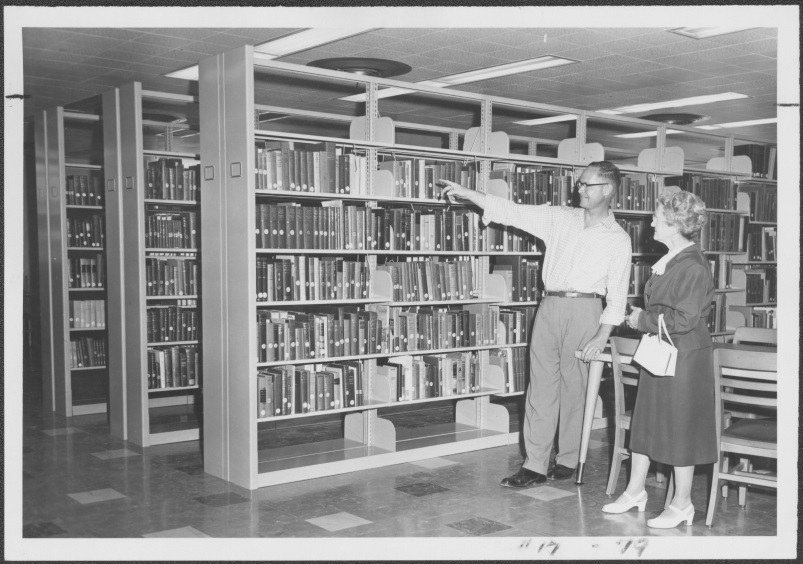
In the decades that followed, Coe Library continued to evolve alongside the university it served. In 1962, longtime Director James Ranz moved into the role of Vice President for Academic Affairs, with Ray Frantz assuming the directorship. By the late 1960s, the Libraries expanded their reach through new services such as the Health Sciences Information Network, providing document delivery to medical professionals across Wyoming.[2] Leadership shifted again in 1969 with the appointment of James H. Richards, Jr.[3] In 1970, the rapid growth of scientific disciplines on campus led to plans of transferring science and engineering materials from Coe to a newly established Science and Technology Library in the George Duke Humphrey Science Center.[4][5]
The 1970s brought further modernization, including a shift from the Dewey Decimal system to the Library of Congress system.[6] The Libraries absorbed the Film Library in Knight Hall in 1971, renaming it Audio Visual Services, while President Humphrey and the Board of Trustees initiated plans in 1973 for an expansion to Coe Library.[7] Leadership temporarily shifted in 1974 when former director James Ranz returned as interim director, followed by the appointment of Robert H. Patterson in 1975.[8] That same year, Coe Library installed electronic security gates, an innovation that dramatically reduced material losses to just 1.3%.[9][10]
By 1977, the library was preparing for its first major physical expansion since the 1950s.[11] With $5.17 million in legislative funding approved the previous year, construction began on the stack tower addition. The project added more than 60,000 square feet, seating for roughly 800 patrons, and capacity for an additional 250,000 volumes. The new space also introduced modern amenities, including air conditioning, a public address system, telephones on each floor connecting to the central information desk, and wiring that anticipated future audiovisual technologies. That same year, the Libraries entered the emerging era of computerized research, offering patrons remote bibliographic searches through the Bibliographical Center for Research in Denver, an early step toward the digital information environment to come.[12]


The University of Wyoming has earned its Research Level 1 (R1) status from the Carnegie
Classification of Institutions of Higher Education, placing Wyoming's only four-year
university among the top research universities in the United States.
The University of Wyoming Libraries has been a Federal Depository Library since 1907. The collection comprises approximately 1.5 million print and microfiche
items in Coe Library and Library Annex, as well as maps, aerial and infrared photographs,
and geological publications housed in the Brinkerhoff Geology Library. The Federal
Document Library Program is changing from physical to digital distribution of government
information; UW Libraries provides access to online publications available from the
Federal Depository Library Program through the library catalog.