
The expansion of Coe Library opened yet another new chapter for the University of Wyoming Libraries. Beyond enlarging the building, the expansion also reconfigured the campus as a whole. The changes allowed the Reference Department to offer tours and instruction sessions for various University departments, reflecting a growing emphasis on user services and academic support. In 1979, the new East Wing was formally dedicated, and the Science Library began plans to expand.[1][2]
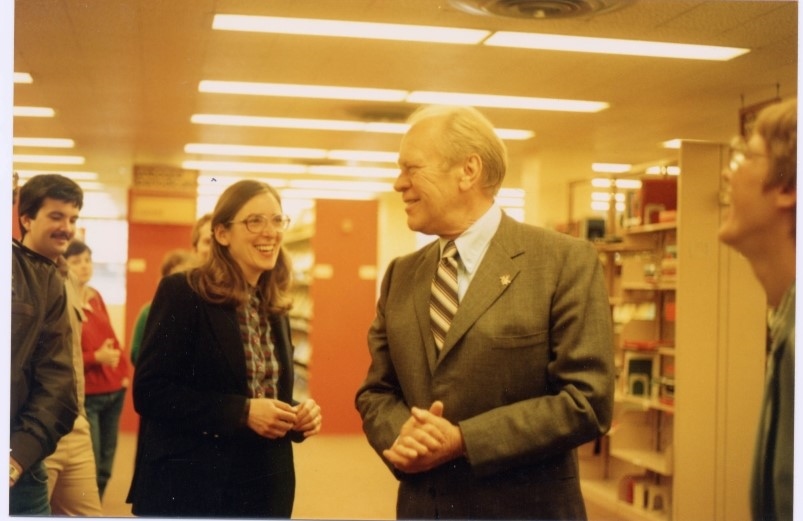
The decade also saw rapid advances in library technology and access. In 1980, the Libraries implemented the CLASSIC computerized management system, joining other state libraries in adopting an online catalog and computerized circulation.[3] The Libraries continued to broaden their reach beyond campus, taking responsibility in the 1980s for the UW–National Park Service Research Center library at the AMK Ranch in Grand Teton National Park. As the University’s collections grew and services expanded, the Libraries experienced leadership changes when Keith M. Cottam became Director of Libraries in 1983.[4] In 1984, former President Gerald Ford visited Coe Library to review an exhibit of Wyoming accomplishments during his administration.[5]
This era continued to bring new systems and new space. In 1985, the Libraries introduced an online catalog, initially available at reference desks and later accessible to all users.[6] A year later, the American Heritage Center announced plans to relocate to a new facility, and the vacated space in Coe was to be repurposed for collection development and technical services.[7] The Libraries also assumed management of the Learning Resource Center in the Education Building. That same year, the Libraries transferred botany materials to the Rocky Mountain Herbarium, which became a research branch of the Libraries. By 1989, the print card catalog was fully replaced by the online catalog, and the Libraries joined the Colorado Alliance of Research Libraries (CARL), adopting a new library management system to support the growing demands of research and scholarship.[8]
The 1990s were defined by continued growth in collections, services, and technology.[9][10] In 1990, the Libraries celebrated acquiring their one-millionth volume, a milestone that reflected decades of steady expansion.[11] Freshman University Studies courses introduced students to Coe through library instruction and tours, while outreach programs extended services to off-campus students and faculty. The Libraries also streamlined services by combining departments and reorganizing spaces to better serve patrons. During this period, the Libraries launched their first Internet homepage and began acquiring web-based databases and journals, a change that would reshape how users accessed information.[12][13][14] In 1997, Coe opened its first electronic classroom, and UWIT added a computer lab on the main floor, further integrating technology into library instruction and student learning.[15]
As the new millennium began, the Libraries continued to modernize and expand their facilities and partnerships. In 1999, the Geology Library was remodeled and renamed the Brinkerhoff Earth Sciences Information Center, and Coe’s map collections were transferred into the Barlow and Haun Map Room.[16] In 2000, wireless service was introduced in Coe, and the Libraries migrated from the catalog system to Voyager, renaming the online catalog “Ferret.”[17] In 2002, Maggie Farrell was appointed Dean of Libraries, and the University’s Capital Facilities Plan included a new Information, Library, and Learning Center (ILLC) addition to Coe. That same year, the Libraries joined the Wyoming State Library to offer statewide access to online databases through the WyLD system, expanding the University’s impact beyond campus.
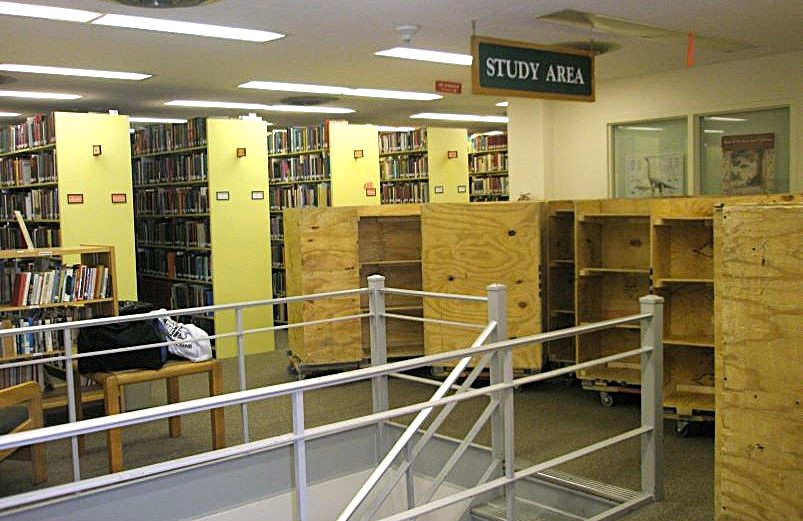
The mid-2000s experienced further growth in community engagement and campus amenities. In 2004, the University Libraries Development Board was established to strengthen community relations and fundraising. The following year, the Book and Bean coffee shop opened on Coe’s main floor, reflecting the Library’s evolving role as a social space as well as academic. Furthermore, plans for Coe Library's next update and expansion were announced, setting the stage for a new and improved library experience.[18] In 2006, the Science Library was remodeled to add compact shelving and prepare for the planned renovation and expansion of Coe; services were reorganized to support access to Science and Annex materials during construction.[19] The Libraries also joined Prospector, a regional catalog that allowed users to borrow directly from member libraries. By 2007, the Library Annex reopened with expanded shelving capacity, and the former Anthropology and Law building was razed to make way for the future Coe addition. In the same year, Coe Library celebrated its 50th year anniversary, and also announced construction plans to expand.[20][21]
Throughout these decades, Coe Library’s identity as the state’s leading research library was strengthened through sustained growth, expanded service models, and the continued development of specialized collections and branches.[22] The Libraries’ commitment to preserving Wyoming’s history and supporting scholarship was evident in the ongoing development of special collections, including the Hebard Collection and other regional archives, as well as the integration of research resources like the Rocky Mountain Herbarium and the Brinkerhoff Earth Sciences Information Center.[23] By 2008, the Library had become not only a center of learning for the University but also a critical resource for the broader state community.
Keith M. Cottam
Dean of UW Libraries
1983 - 2001
Maggie Farrell
Dean of UW Libraries
2002 - 2015


The University of Wyoming has earned its Research Level 1 (R1) status from the Carnegie
Classification of Institutions of Higher Education, placing Wyoming's only four-year
university among the top research universities in the United States.
The University of Wyoming Libraries has been a Federal Depository Library since 1907. The collection comprises approximately 1.5 million print and microfiche
items in Coe Library and Library Annex, as well as maps, aerial and infrared photographs,
and geological publications housed in the Brinkerhoff Geology Library. The Federal
Document Library Program is changing from physical to digital distribution of government
information; UW Libraries provides access to online publications available from the
Federal Depository Library Program through the library catalog.