
SOLID SAMPLE PREPARATION
WEIGH SAMPLES ACCORDING TO SUBSTRATE AND ANALYSIS
- Correct weights can be found below in the weights and template section.
- Carbon-only analysis requires much less material If your substrate is not on the list, contact SIF.
- Soils usually need to be tested before the correct weight can be determined.
THOROUGHLY DRY SAMPLES
THOROUGHLY RINSE ACID-TREATED SAMPLES
- 5-8 rinses are typical
- Test the ph to ensure samples are neutralized
USE PROPER CAPSULES
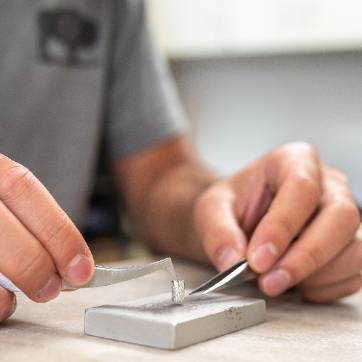
- Load samples in the proper size and type of capsules.
- Use the smallest capsule size that will hold the sample with no leakage
- Order the 3.5x5 mm, 4x6 mm, and 5x9 mm capsules from USA Analytical.
- Silver capsules are used for TCEA (δ18O / δ2H) samples
- Tin capsules are used for EA (δ13C / δ15N / δ34S) samples
CLEAN
- Keep the working area, weighing table, spatula, and forceps very clean.
EVAPORATE ETHANOL
- Wipe the forceps and spatulas with an ethanol-soaked Kimwipe in between subsequent samples.
- Make sure ethanol is evaporated from the tools before letting them come into contact with a sample.
CAPSULE SHAPE MATTERS!!
- Capsules should be folded and crushed into a cube or ball without any protrusions.
- Samples that are flat or have protrusions tend to get stuck and lost in the sample carousel.
RECORD WEIGHT AFTER ENCAPSULATION
- Record the final weight after the capsule is sealed. Please ensure that no sample is leaking from the tin.
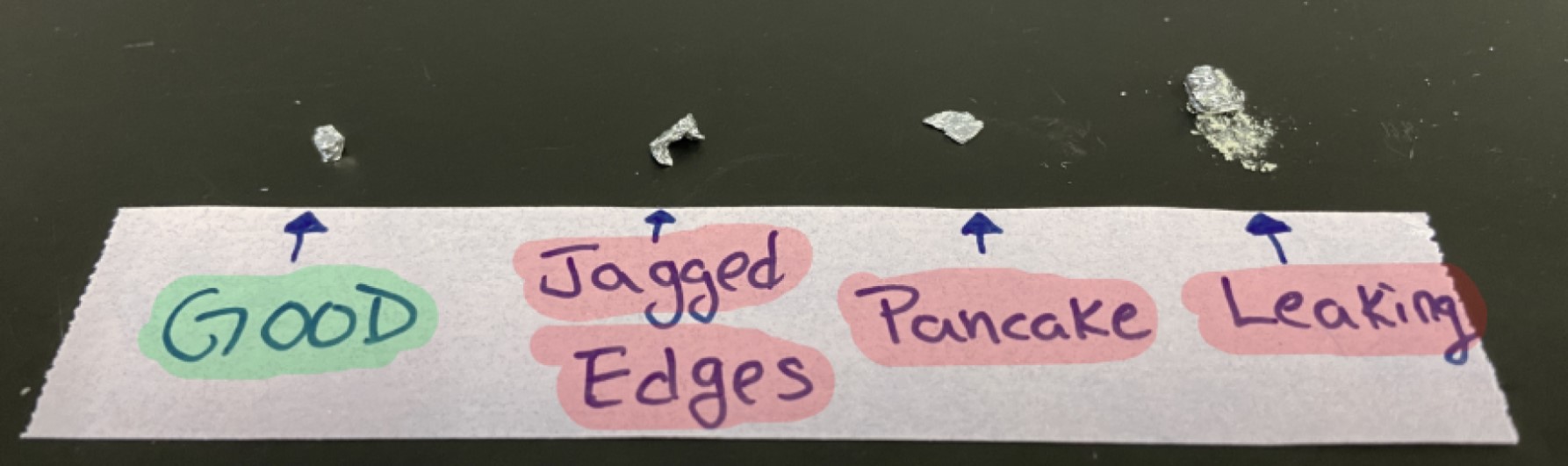
Pictured above: Your capsules should not have jagged edges, be flat, or leaking. This can cause sample loss.
Organization and shipment
LOAD SAMPLES ACCORDING TO TRAY TEMPLATE
- Template used depends on sample tin size and analysis. See template section below
- Leave wells marked for lab standards empty
- Use 96 well plastic trays
- If UWYOSIF is loading samples leave weight column empty.
SAMPLE NAMING
- Replicates can have identical names
- Do not include special characters in sample IDs
- Hyphens and underscores are acceptable
- Names should not be longer than 20 characters
GROUP LIKE SAMPLES TOGETHER
- ENRICHED SAMPLES
- Load in order of enrichment low to high
- Load natural abundance samples in different tray
- MIXED SUBSTRATE SAMPLES
- Group samples of similar material together, e.g., keratin with keratin and plants
with plants.
- If different types of samples e.g., keratin, chitin, plant, are all in the same tray, label substrate type in preparation notes in the template.
- Group samples of similar material together, e.g., keratin with keratin and plants
with plants.
SHIPPING SOILS
- Soil permit must accompany any soil samples being shipped to UWYOSIF per federal regulations.
- Contact SIF before sending samples, for permit and instructions.
SAMPLE CONTAINERS
- Samples can be sent in eppendorf tubes, glass/plastic vials, or envelopes.
- Clearly label the container with the same label used on the tray loading template.
SECURING TRAY
- Secure the tray and lid with two pieces of tape on opposite sides of the tray and
label and number the tray accordingly.
- Do not use parafilm or completely wrap the tray in tape. This makes it difficult to open without samples jumping out of tray.
SHIPPING TRAYS
- To ensure samples stay in wells during shipment cut a piece of card stock or thin cardboard and place it in between the tray and the lid.
- Pack shipment boxes well enough to prevent breakage or loss of sample.
- Shipping envelopes are not suggested because damage can occur during shipment and samples can be lost.
- UWSIF is not responsible for sample loss due to packaging and shipping.
HYDROGEN ANALYSIS
- If submitting samples for solid hydrogen analysis, please contact SIF before sending.
- Hydrogen analysis can be complicated because sample hydrogen readily exchanges with atmospheric hydrogen.
- Special procedures must be followed in order to get accurate results.
- Special preparation charges may apply.
Sample WEights and Templates
Improper weighing of samples can lead to time and sample loss.
Choose the correct template based on size of tinned samples and analyis type below.
Note: carousel is not determined by the number of samples.
- 100 Carousel <3.5mm
- 50 Carousel 3.5-7.5mm
- 32 Carousel 7.5mm-11.5mm
If you use the incorrect template for your weighed samples, it will require additional handling of your weighed samples. The more your samples are handled, the more room there is for error.
The weights listed below are recommendations if you know the elemental composition of your samples try our sample weight calculator.
| Sample Type | Weight in mg (milligrams) | Sample Sheet Template |
| Eye Lense | 0.2-0.3 |
δC13, δN15, &δS34 (natural abundance) |
| Muscle/Tissue | 0.7-0.85 | |
| Plants | 2.0-2.5 | |
| Soils |
Contact SIF to TEST
|
| Sample Type | Weight in mg (milligrams) | Sample Sheet Template |
| Blood | 0.5-0.6 | 100 Carousel δC13, δN15 (natural abundance) 50 Carousel δC13, δN15 (natural abundance) 32 Carousel δC13, δN15 (natural abundance) 50 Carousel δC13, δN15 (isotopically enriched) |
| Keratin | 0.5-0.85 | |
| Collagen (Bone) | 0.7-0.85 | |
| Chitin (Insect) | 0.7-0.85 | |
| Muscle/Tissue | 0.7-0.85 | |
| Plant Stem, Leaf | 2.0-2.5 | |
| Roots | 4.0-4.5 | |
| Soils | Contact SIF for Testing | |
| Other | Contact SIF |
| Sample Type | Weigh in mg (milligrams) | Sample Sheet Templates |
| Blood | 0.2-0.3 | 100 Carousel δC13 (natural abundance) 50 Carousel δC13 (natural abundance) 32 Carousel δC13 (natural abundance) |
| Keratin | 0.2-0.3 | |
| Collagen (Bone) | 0.2-0.3 | |
| Chitin (Insects) | 0.2-0.3 | |
| Muscle/Tissue | 0.2-0.3 | |
| Plants | 0.2-0.3 | |
| Roots | 0.2-0.3 | |
| Soils |
Contact SIF for Testing |
|
| Cellulose | 0.2-0.3 |
Weigh in SILVER capsules
| Sample Type | Weigh in mg (milligrams) | Sample Sheet Templates |
| Blood | 0.2-0.3 | TC/EA δD & δ18O |
| Keratin | 0.2-0.3 | |
| Collagen (Bone) | 0.2-0.3 | |
| Chitin (Insects) | 0.2-0.3 | |
| Muscle/Tissue | 0.2-0.3 | |
| Plants | 0.2-0.3 | |
| Cellulose | 0.2-0.3 | |
| Phosphates | 0.2-0.3 |
| Sample Type | Weight in mg (milligrams) | Sample Sheet Template |
| Blood | 0.5-0.62 | 100 Carousel % CN 50 Carousel % CN 32 Carousel % CN |
| Keratin | 0.5-0.85 | |
| Collagen (Bone) | 0.7-0.85 | |
| Chitin (Insect) | 0.7-0.85 | |
| Muscle/Tissue | 0.7-0.85 | |
| Plants | 2.0-2.5 | |
| Roots | 4.0-4.5 | |
| Soils | Contact SIF for Testing | |
| Other | Contact SIF |
Ready to place your order
Now that you've chosen the correct template and have properly prepared your samples, you are ready to place your order!
Ship Samples to
UWYOSIF
DEPT 4304
1000 e University Ave
Laramie, WY 82071

The University of Wyoming has earned its Research Level 1 (R1) status from the Carnegie Classification of Institutions of Higher Education, placing Wyoming's only four-year university with the top research universities in the United States.